
What a Data Driven Rankings System Makes of the New Baseball America Top 100
We explore what key similarities and differences in BA and Oyster rankings tell us about top prospects, scouting, and modeling


The pre-season Baseball America top 100 is out, a nice taster course before the obvious main event of our 2026 top prospects release again in March.
We’re not naive egomaniacs. We know the releases of these lists make many more waves in prospect land than our Substack articles and projections do, and we’re big admirers of Baseball America’s (BA) commitment to high-quality scouting. We have our differences of opinion, of course, but we’re also broad-minded enough to know that (obviously) what they provide has significant value. To know exactly what kind of value that is, check out our two articles that have evaluated the performances of mainstream prospect rankings sources.
In the spirit of collaborative learning and knowledge creation, in this article we highlight players who are either loved by both our (Oyster) model-based projections and BA, are Oyster darlings and BA snubs, or are BA favorites and Oyster underdogs. In doing so, we hope to provide insight not just about the key prospects included, but also more broadly about the advantages and shortcomings of different modes of player evaluation, and what can be learned from taking them together in tandem. Let’s go!

Everybody Loves…
Kevin McGonigle (DET)
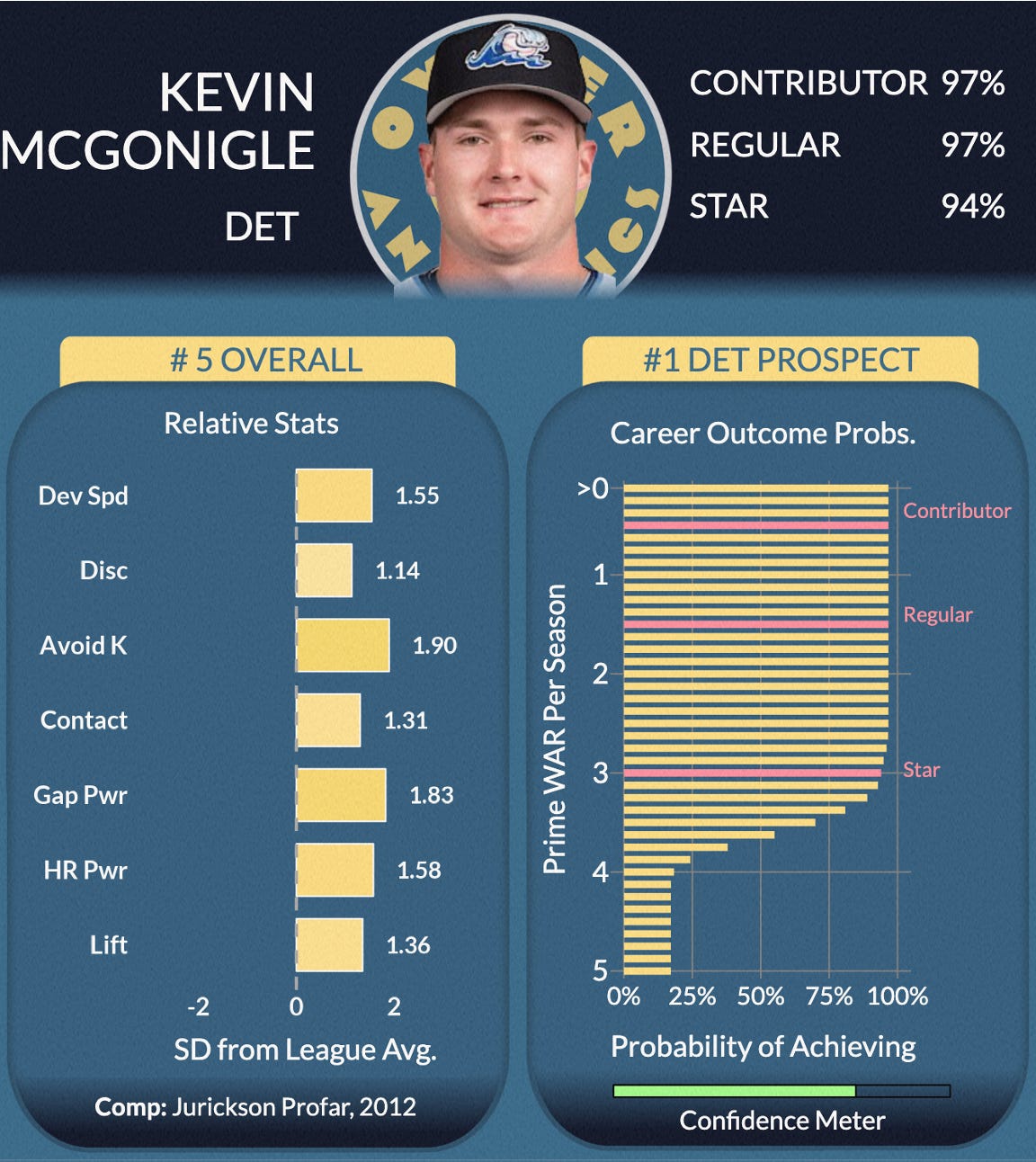
We have mostly had Kevin McGonigle at number five in our prospect rankings, and we have miraculously waited out the mainstream effectively enough that this ranking has gone from ridiculously aggressive to slightly conservative.
McGonigle spent a lot of time in the Data Darling, Scout Snub bucket, but has hit his way through the eye-test-based doubts. He suffers from a few things that scouts tend not to like–small, not super athletic stature, fringy ability at SS, and, until 2025, a lack of game power. On the flip side, he’s always had quite literally all of the things that our model loves. Let’s run through them:
Extremely strong performance in sticky areas while highly over-leveled (he played in A-ball at just 18 and spent most of 2025 in Double-A at 20, where the average age is over 23)
Incredible bat-to-ball skills (never a K rate above 12.6%) that have not diminished as he’s climbed levels
Great discipline that has likewise continued even against more advanced (and accurate) pitching—this guy is not passive, he’s patient (16.0% BB rate in Double-A in 2025)
Demonstration of underlying tools that suggest power projection (until this past year, he hadn’t been a home run threat, but he’s always hit XBH, lifted, and hit for a high average, suggesting he has the ability to hit the ball hard and high)
Continued ability to play shortstop (even if it doesn’t continue at the MLB level, we know that playing there continuously in MiLB indicates a higher likelihood of being a value-add on defense somewhere around the diamond)
What more can we say? Plenty, but we’ll keep it short. McGonigle is the platonic ideal of the Pure Hitter archetype, and our conviction in him is further strengthened by the fact that scouts have come around as well. Did we mention his 162 wRC+ in Double-A came despite a hugely unlucky .230 BABIP? When that regresses (progresses?) to the mean, yeesh. Nobody is a sure thing, but we have McGonigle at a 94% chance to be a Star by our standards, which, combined with the full-throated BA endorsement, gives this guy the bluest chip he could hope for.
What Does the McGonigle Case Tell Us About Analytics and Scouting?
It’s not that scouts are never willing to get behind guys with unremarkable physiques, but rather that the evidence of their talent has to be far more overwhelming to get them the love they might otherwise receive. We think McGonigle is a perfect example of a guy better identified early by trusting (well-handled and used) data, which is unfazed by his physical appearance and takes his performance at face value.
Colt Emerson (SEA)
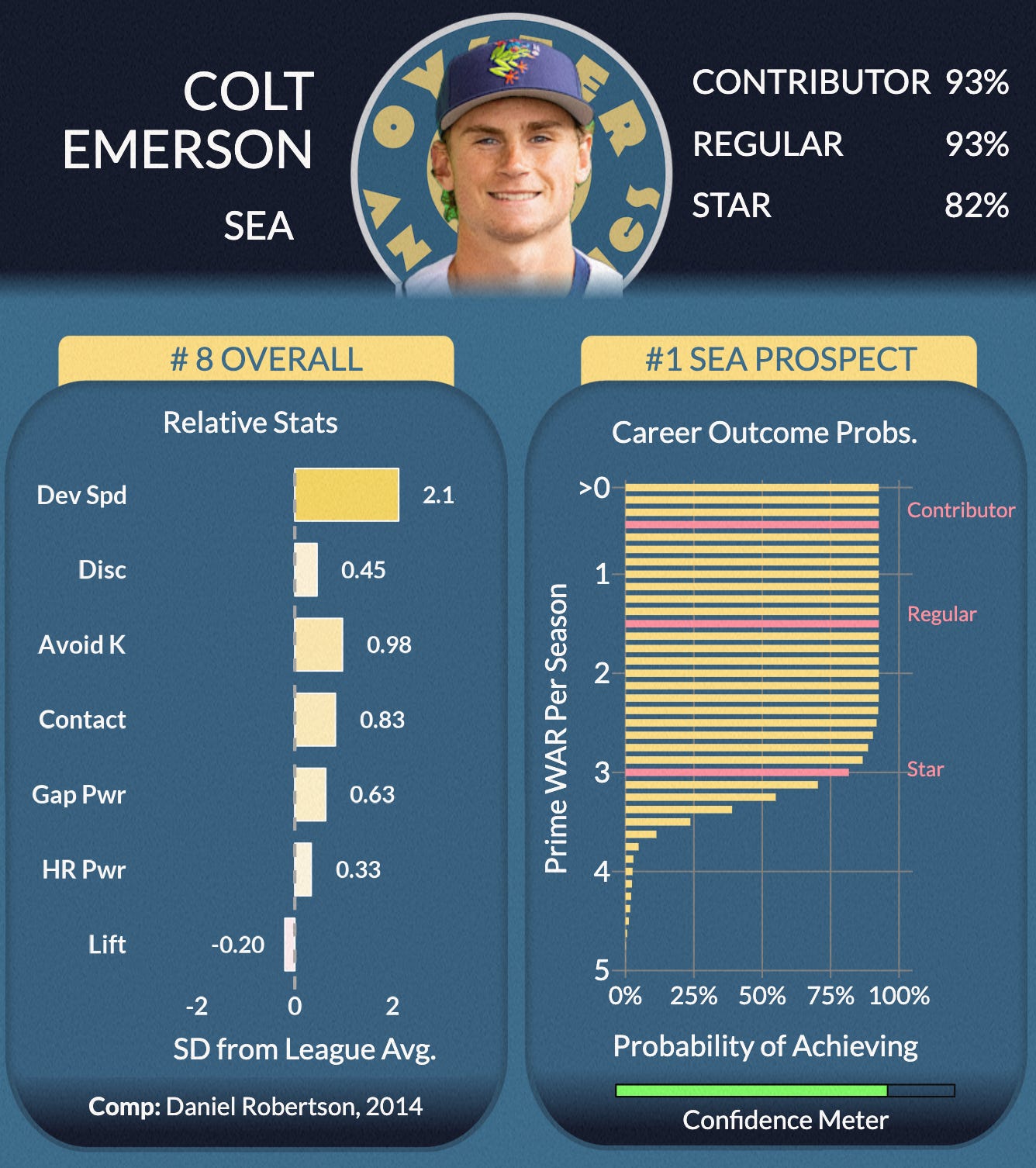
Emerson had a bit of a slow 2024, as injuries limited him to 70 games and may have contributed to his mediocre 84 wRC+ in 139 High-A PA. Both we and BA still had faith, though, ranking him in our respective top 25 hitters leading into 2025. We both loved his sophisticated and mature approach, and with a power surge and continued contact improvement, he’d be a scary proposition. In 2025, he made all the strides, upping his HR total from four to 16 (in just over double the PA), maintaining his solid contact rate, and avoiding Ks at around the same level as his two prior seasons at lower levels.
His development mirrors that of McGonigle, but with a more projectable build: a “pure hitter” type player that gains power as they mature. These archetypes are especially strong, as they often lack the holes in their swing that can plague HR-only threats, yet possess the pop to prevent pitchers from grooving strikes, boosting both SLG and BB capabilities. A key to his growth was a clean bill of health in 2025, and getting 130 games under his belt was important after a developmentally challenging 2024.
Reportedly, Emerson will get a shot at the opening day roster to begin 2026, where he will most likely compete with Ben Williamson for the third base job. Third base may not be Emerson’s only option; BA cites an improved SS glove in 2025 that could give him MLB playability there, a contrast to his likely-3B projection entering 2025. We think Emerson has the chops to compete right away, as he’s a solid all-rounder with minimal flaws who looked good in High-A, Double-A, and in his late season Triple-A cameo in 2025. If 2025 had some injury-sparked hesitation on Emerson, 2026 signifies a consensus that he’s both the real deal and a near MLB product.
What Does the Emerson Case Tell Us About Analytics and Scouting?
Stick beside big talent after turbulent seasons, especially when injured, and especially when young. Emerson flashed big-time potential in 2023, completely dominating the Complex and Single-A levels in his 114 PA at age 17. Even as his age 18 season had setbacks, he still showed a complete and mature approach beyond his years. Those exceptional traits very rarely float off into the wind, and Emerson (and players like Alfredo Duno (CIN)) more often than not find their form as they find a healthy run of play.
Samuel Basallo (BAL)
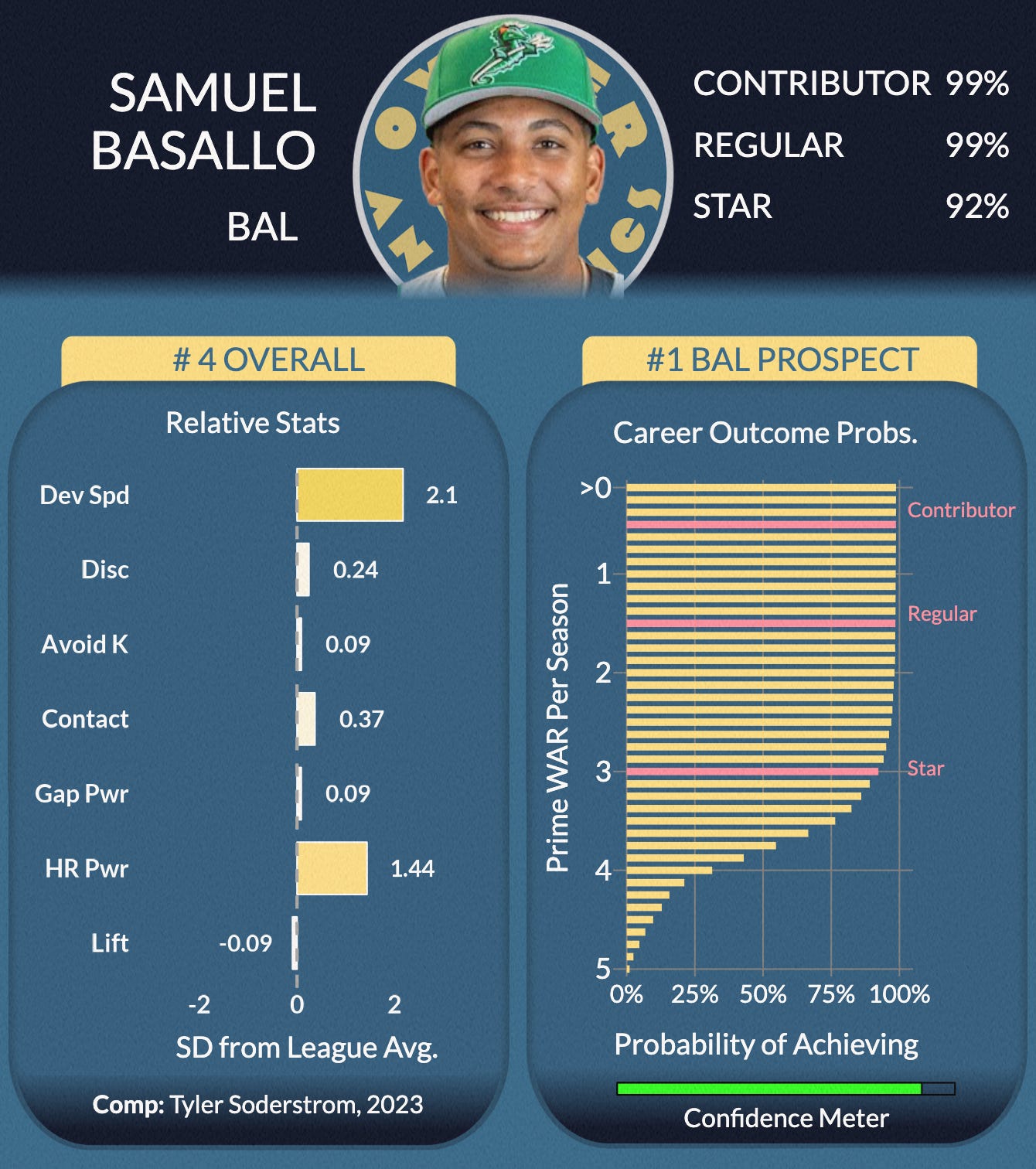
If power was a question with the previous two prospects, it is emphatically not with Basallo—he answered that question at age 17. After a five HR, 154 PA DSL run in 2021, he hit six more in 180 PA in the Complex at 17, fifth most since 2021 among those his age or younger at that level. In 2023 and 2024, he blossomed into the complete package, posting high averages (.313 and .278, respectively), smashing 19 jacks in 2023 and 20 in 2024, and keeping the Ks around 20%. Our model wasn’t totally sold on Basallo based on his relatively low walk rate in 2024 (8.6%), which, when paired with an okay but not exceptional 72.0% contact rate, raised concerns about his ability to handle the upper levels. We had him 17th headed into 2025 (a bit lower than BA), displaying a mutual unwillingness to deem him an elite prospect.
Then, Basallo was, quite frankly, a monster in Triple-A in 2025:
He hit 23 homers in 211 fewer PA than his 20-homer 2024
Upped his walk rate to an elite 13.7%
Increased his fly ball rate by ~10 ppts. to 40.0%
Slashed his infield fly ball rate from 30.3% to 12.8%
Hit just under 30% of his fly balls for home runs
Any doubts that the Orioles (and our model) had about his development were answered with his massive age-20 campaign. In fact, only Ronald Acuña Jr. (ATL) had a higher Triple-A wRC+ at 20 or younger with 200+ PA. Basallo’s demo job of Triple-A earned him an MLB cameo at the end of the season, in which he struggled, hitting too many ground balls and chasing too much. Twenty-year-olds in the bigs tend to have these issues, however, and with a full offseason, we’re excited to see what Basallo does at the dish in 2026.
As a catcher in Triple-A in 2025, Basallo had a mediocre CS record, nailing only six of 47 base stealers despite reportedly great arm strength. In the bigs, it was a completely different story, as the Orioles diligent runner jockeying allowed Basallo’s arm to shine, nailing five of 13 base stealers. Basallo maintained a solid CS% in his previous seasons, so we expect more of the same from the bazooka-armed C in 2026. BA has some doubts about his current mastery of the fine arts of catching (receiving/game calling), which is an unavoidable flaw of almost any 20-year-old catcher. With catchers already developing more slowly than other players, it makes sense that a hyper-accelerated catcher needs some additional seasoning. Complicating things further have been the struggles of Adley Rutschman, which, if they persist, could open a clear line for Basallo to be the catcher of the future.
We now rank Basallo fourth, and BA is similarly bullish, a clear indication of Basallo’s transition from a really good prospect to one of the best catching prospects in recent memory.
What Does the Basallo Case Tell Us About Analytics and Scouting?
If you hit, you’ll get the prospect buzz! Even with some criticizing his comparatively immature catching game, holding a prodigious bat down to get the catching experience he needs to be a polished defender isn’t productive. Instead, the O’s seem content to let him learn on the biggest stage, giving him the irreplaceable years of catching experience he needs to turn into the complete product behind the dish.
Other Notes on Crowd and Computer Favorites
Sebastian Walcott (TEX) and Bryce Eldridge (SFG) are the rare Oyster favorites who look the part—physically impressive and toolsy, making it unsurprising that the scouts have similarly high opinions of them. The best way to get in this category is to show flashy tools in the eye test while also getting it done in the boring ways on the field, while playing against older competition.
Data Darlings, Scout Snubs
Leo De Vries (ATH)
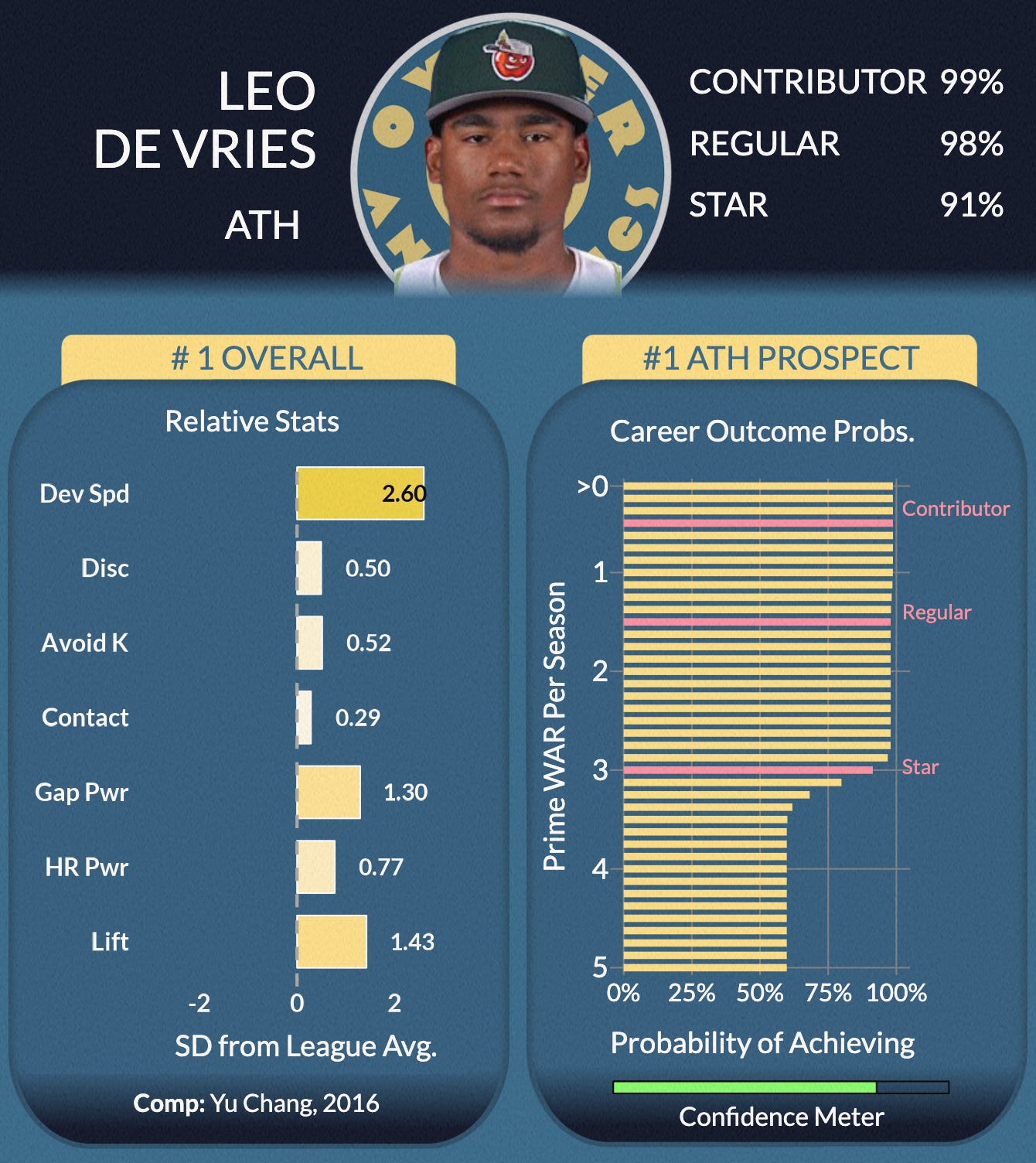
For the past year and a half of working on our model and Shiny app, we opened our work to see De Vries’ smiling mug, as he was, and has been, nearly every month since, our number one prospect. Calling him a snub on the scouting side may seem harsh, but that’s a reflection of just how highly our model thinks of De Vries. He ranks just outside of Baseball America’s top 10, but we think he’s the best young starlet in the land.
Succinctly, De Vries checks all of the boxes, possessing solid high-end power, good contact skills, solid discipline, elevating the ball exceptionally well, and is still a teenager doing it all in High-A and Double-A. To contextualize the absurdity of his performance, his hard slugging yet disciplined 144 wRC+ in 103 PA in Double-A is the only above-average Double-A wRC+ campaign from an 18-year-old; not even Bryce Harper (PHI) carried that wRC+ at that age!
Unlike some young prospects who get by with some absurdly high BABIPs, mitigate mediocre K rates with punishing mistakes, or struggle to make contact or walk, De Vries has few signs that he won’t be able to keep this up at a high level. His contact rate has only increased over time (73.8% in 2025 pre-trade, 75.7% post-trade, and 80.6% in Double-A), he carries ground ball rates in the low 30%s, and he has kept his K rate at and around 20%. Again, he’s doing this at 18!
Sure, his youth and lack of upper-level experience give him higher bust potential than more touted BA prospects like McGonigle or Walker Jenkins (MIN), but we love the upside enough to put him above those guys anyway. BA cites divided opinions on his power potential as key in De Vries’ projectability, but with his awesome launch angles and proven track record (he hit 15 in 2025 at age 18), we think plus power is in his future.
What Does the De Vries Case Tell Us About Analytics and Scouting?
Age matters a ton in player evaluation, and while it’s tempting to reserve the lofty spots for those who put up eye-popping numbers (which De Vries did not), we think it’s okay to put above-average but incredibly young players in these spots. We saw this with McGonigle and Luis Peña (MIL) pre-2025, and our faith was rewarded. For us at Oyster Analytics, this has been an area where we’ve found undervalued talent, and it’s perhaps our biggest differentiator between us and the mainstream outlets.
Ryan Clifford (NYM)
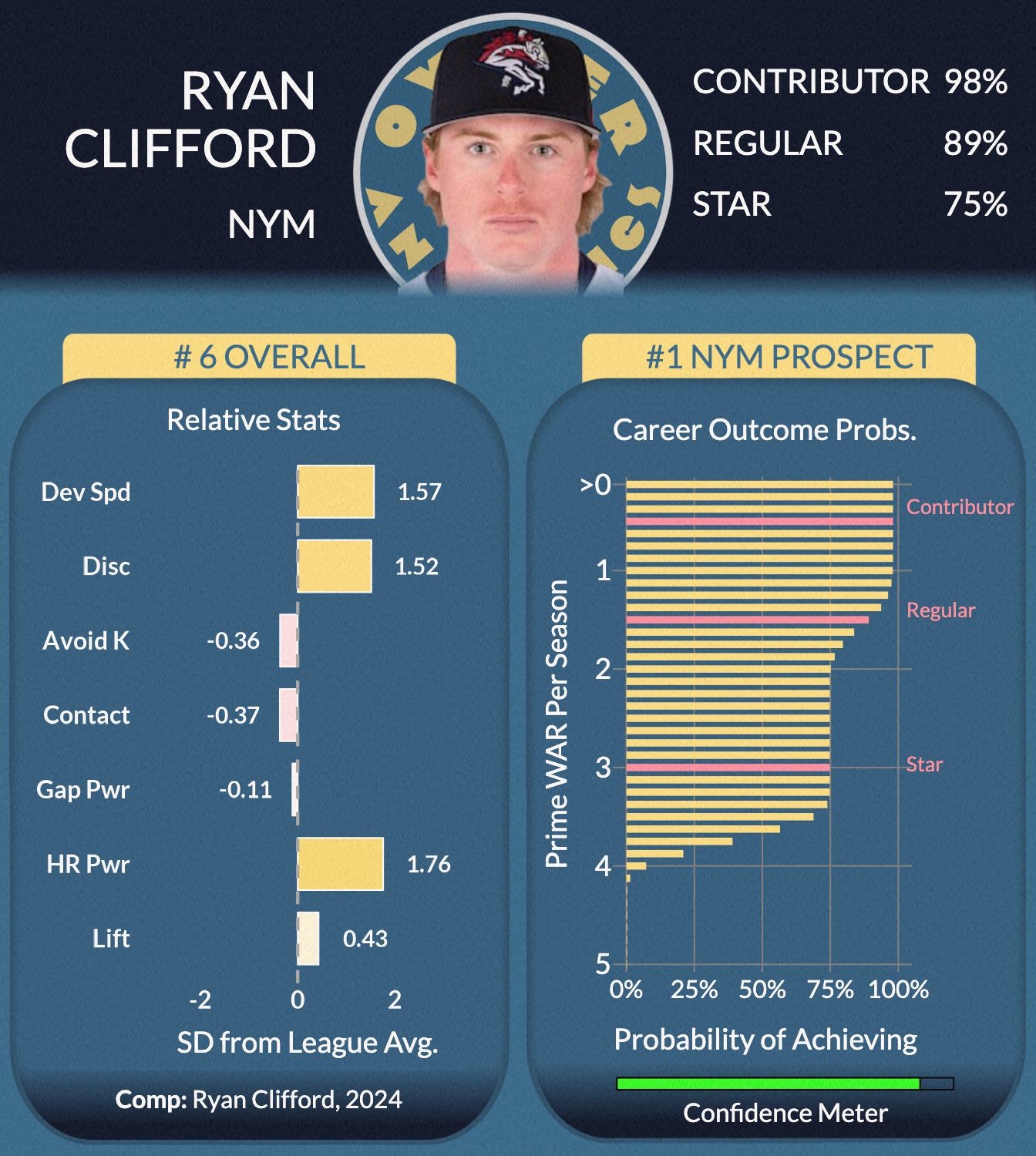
Clifford has been near the top of our lists for a while; we had him ranked 29th overall pre-2025, and wrote this:
Either of us here at Oyster could pitch in Coney Island right now and probably manage to keep almost all left-handed batters except Barry Bonds in the ballpark—we can confirm from personal experience that the wind really does blow in that hard from right field, which faces the ocean with very little structure to block the airflow. So forget Clifford’s one home run in 31 games there last year, and focus on his 18 in 98 games in Double-A as a 20-year-old. The power is even better than what the overall stats show so far, and Clifford projects as a three true outcome hitter whose strong discipline should keep his OBP high enough to make him more than a home run or bust guy.
In 2025, Clifford got even better, clubbing 24 HR in 437 Double-A PA before adding five more in 142 Triple-A PA to end the season. The power is real, and it is spectacular! Most notable about his progression is his solid strikeout and walk rates. His K rate dropped to a career-low 25.6% in 2025, and was actually lower in Triple-A than in Double-A. Meanwhile, his walk rate remained high at 14.7%; his OBP was .119 points higher than his average, which means something at the Double-A and Triple-A levels. Sure, he’s got three true outcomes, but he’s a lot better at finding the two good ones than most 21-year-old power prospects.
Baseball America has him just outside of the top 100, despite a rather glowing evaluation that praises his progress on the contact front. They’re hit-tool pessimists, which is somewhat fair, but we believe his sophisticated approach and decent contact rates portend success in MLB. Of all prospects 21-and-under, he was second in HR in 2025, behind only Lazaro Montes (SEA), and Clifford avoids the contact scaries that some of the top HR guys possess. In a system with tons of strong-hitting OF (but one less today than two days ago), we think Clifford is the best of the lot!
What Does the Clifford Case Tell Us About Analytics and Scouting?
Power plays! The “three true outcomes” label is conferred on many prospects in a negative light, but if you’re hitting homers and taking walks at over one-and-a-half standard deviations better than average at an age multiple years younger than your opposition, you’re a real threat. Even if he projects as a low .200s hitter in the show, 30+ HR with a .350+ OBP doesn’t seem too radical an outcome. Even incomplete hitters deserve praise if their strengths are mighty; heck, Aaron Judge (NYY) is simultaneously a flawed, relatively low-contact hitter and one of the best of all time!
Edwin Arroyo (CIN)
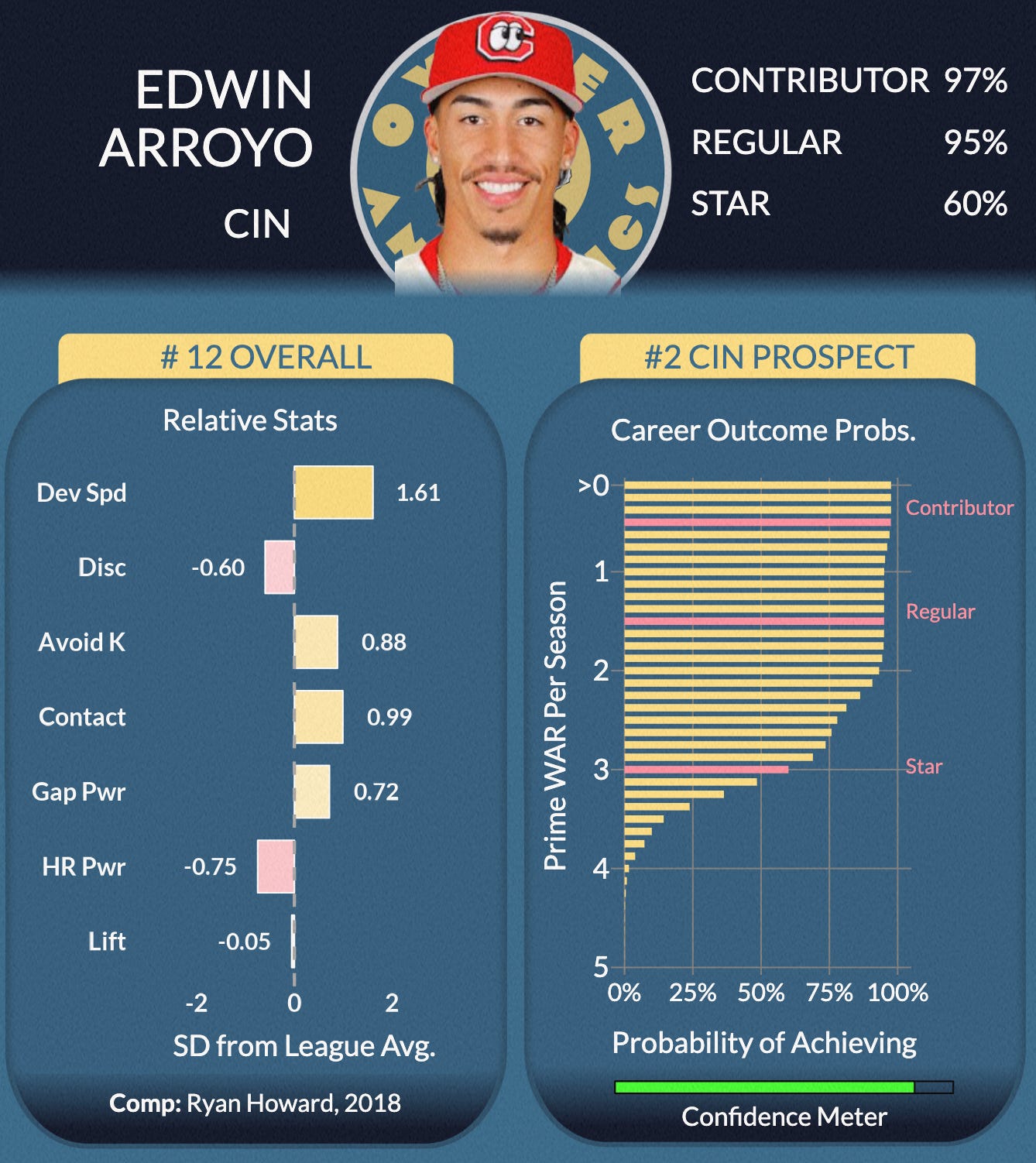
We have a confession: we think Baseball America is right to have serious doubts about Arroyo, and that our model is significantly too bullish on him. Gasp!
Arroyo is a data darling with a very real red flag: he missed a full crucial season of development due to injury, and since then has seen some changes to his game that are far from ideal. We know we said earlier to stick by star prospects with serious injuries, but at a certain point, skepticism does become warranted. Colt Emerson, Alfredo Duno, and Jett Williams (MIL) similarly suffered major injuries but dissimilarly came back stronger than ever. For Arroyo, the power has evaporated, ground balls have become more common, and the stolen base threat has faded.
We think some upside is still there, but it’s not perennial All-Star upside, it’s more first-division regular potential. It’s very possible the power still lurks, and it has been encouraging to see Arroyo cut his strikeout rate substantially. He had an above-average season in Double-A at just 21, something our model will take notice of when it’s done at a premium position (shortstop in this case). Arroyo is one to keep an eye on, but we don’t begrudge the good folks at BA for excluding him from the top 100.
What Does the Arroyo Case Tell Us About Analytics and Scouting?
In cases where injuries have taken a major toll on players, it’s worth considering what the scouts have to say even more than usual. In the case of Colt Emerson, whom we detailed earlier, scouts and our model stuck with him. Here, Arroyo has only the support of the numbers. In cases where major external factors are at play, and a model is extremely high on a player, but scouts are not, it’s often more useful to think of the model’s view as “what could be,” not “what will likely be”.
Other Notes on Data Darlings, Scout Snubs
If you’re a frequent Down on the Farm reader, you’ll be familiar with many of these names by now. We’ll highlight just a few here: Hendry Mendez (MIN) is a great example (read about them in our recent AL Central Prospects to Watch piece), as is Justin Gonzales (BOS) (he features in our AL East Prospects to Watch). Jadher Areinamo (TBR) and William Bergolla (CWS) are also among our favorites to write about, in part just because of how weird their respective profiles are (Bergolla is a generational—no exaggeration—bat-to-ball talent, Areinamo is 5’8” but hits tanks). Read more about Bergolla and others in our recent Underrated Prospects piece, and find our various thoughts on Areinamo in a pre-2025 piece, a Beatles-themed profile of his “Twist and Shout” style swing, and an evaluation of his trade to the Rays last summer. The theme here: guys who somehow look or play funky but do the hard stuff well while over-leveled.
Elsewhere, a few catchers headlined by Alfredo Duno (CIN) don’t get the level of reverence we believe they deserve. That jibes with research we’ve done that suggests catchers are among the most frequent misses by scout-based rankings. Read more about Duno in our projection of the 2030 NL All-Star team.
Scout Sweethearts, Data Doubts
Travis Bazzana (CLE)
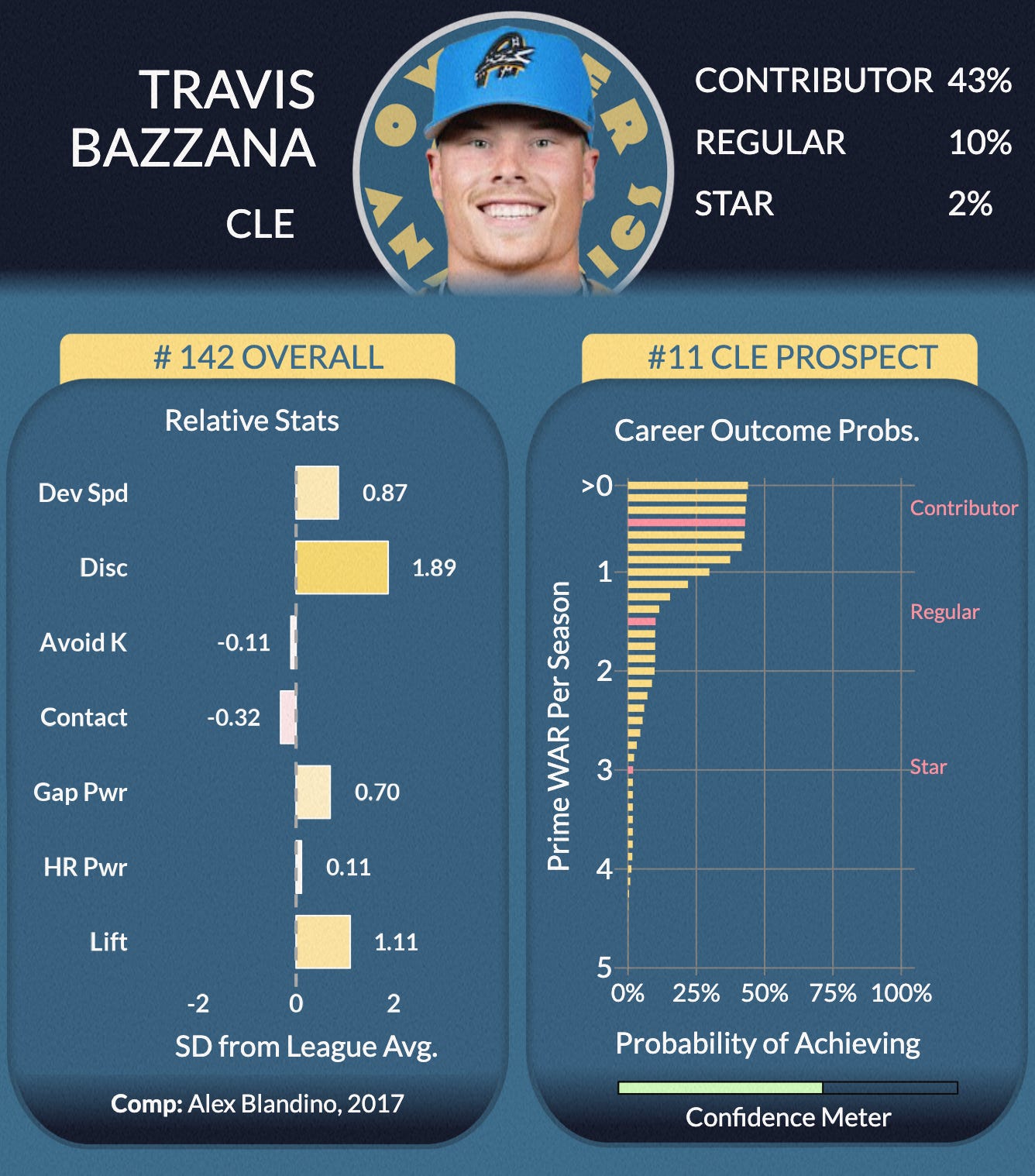
Bazzana is a perfect example of the type of player our modeling is unlikely to be high on, but who will always get love from the more traditional scouting establishment. He had an incredible college career (which we do not include in our model) and did not debut in pro ball until he was 21, or play anything close to a full season of it until he was 22. That’s not the recipe for approval from our model, which loves an over-leveled player and a large track record. It’s also worth noting that Bazzana was drafted as a Second Baseman–he didn’t play a single game at shortstop at Oregon State. That means he’s in a batch of players where large draft bonuses typically have a much lower rate of return–the correlation between bonus amounts and future WAR is far stronger for players at SS, C, and CF.
The Australian, then, was fighting an uphill battle to please our model even before he stepped onto a pro field. What he’s done since then has not assuaged its baseline worries, despite the rather gaudy wRC+s he’s generated across a few levels. A lot of his offensive value has been driven by a walk rate that will surely fall in MLB. That’s no disrespect to Bazzana, just a reality check on what’s possible on that front in the show; Juan Soto (NYM), he of the many walks, takes a free base in about 18% of his plate appearances. In Bazzana’s Triple-A stint, his 138 wRC+ was buoyed by a far higher rate than that, at 24%. Plus, he doesn’t have the power threat that Soto offers and is likely to be pitched more aggressively. Bazzana also strikes out a lot, which is a big no-no for our model unless you’re highly over-leveled and present a serious power threat (see, for instance, Bryce Eldridge (SFG)).
It’s a little difficult to get a handle on why Bazzana is so high in the Baseball America rankings, because the scouting reports they’ve written about him of late have not been entirely glowing. It seems impossible that a positive hangover generated by his college pedigree is juicing his placement in more subjectively assembled rankings. One possible hope for more value seen by scouts that our model is blind to is Bazzana’s potential to make a move to center field, where his plus speed could play without being inhibited by his mediocre instincts in the infield.
In all, we’re confident that our model’s caution is warranted and accurately holds down Bazzana’s 50th percentile future value and his ceiling. There’s probably something to be said for a manual elevating of his “Contributor” status, though. We’ve got that at 43%, but the confidence on the scouting side that this is an MLB player suggests that Bazzana is indeed probably more likely than not to make an impact in the show.
What Does the Bazzana Case Tell Us About Analytics and Scouting?
Pedigree and college performance can have a serious impact on scouting and projection even after the player has made his pro debut. Early on, this is very important to take into account. Since we only rely on pro stats, we’re unable to give confident views on guys straight out of the draft right away. But once players have had a good sample of MiLB appearances—like Bazzana, who has racked up nearly 500 PA—it is often time to take seriously whatever the on-field product is, regardless of amateur performance and hype.
Josuar Gonzalez (SFG)
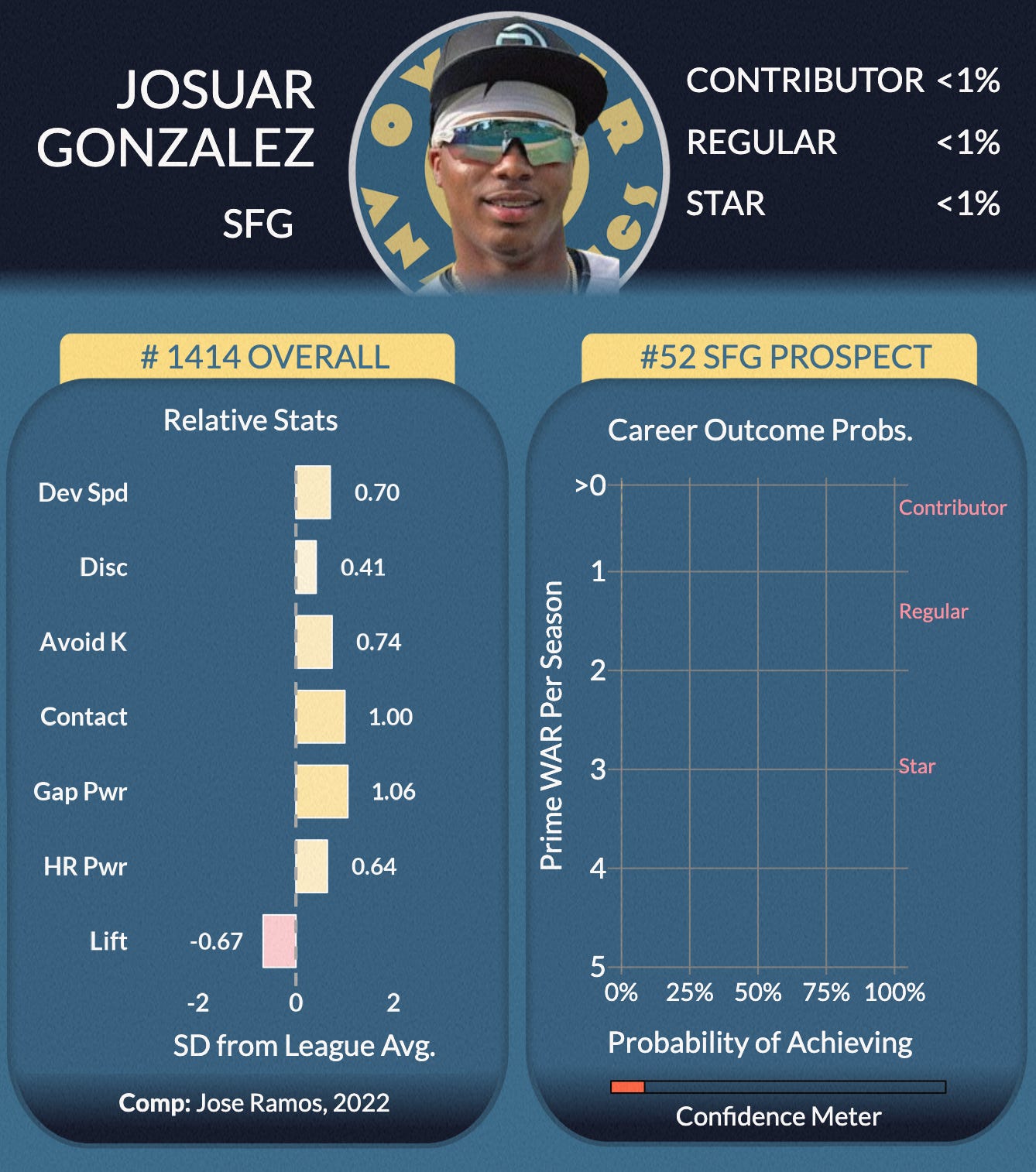
Easily the largest gap in terms of rank between our current projections and Baseball America’s new top 100 comes in the shape of Josuar Gonzalez.
The respectful take: Gonzalez plays extremely good defense that puts a floor on his value few DSL prospects can claim, he has always had a ton of believers (he signed for almost $3 million), and he apparently performed well in unofficial instructional league ball in the states post-DSL season. All of those are things that our model can’t really account for, but that human scouts can, and that explains and justifies his inclusion high on the BA list despite our nerdy skepticism.
The cynical take: this is a vibes-inclusion piggybacking on the huge successes of DSL stud shortstops Jesús Made (MIL) and Luis Peña (MIL) in 2024. BA was late on Peña and middle of the road speed-wise on Made, and perhaps the success of both has made it more fashionable to get wild and include more DSL-only guys high on the top 100 list. We’re right to not have a guy with only 52 pro games, and none stateside, anywhere near the top 100—to earn that, you need to have an absurd DSL season behind you, and Gonzalez does not.
The reality likely lies somewhere in between. No amount of visual scouting is going to sell us on Gonzalez as deserving of a top 100 prospect at this point, but it’s also possible that proves shortsighted. The point is, the risk is just so, so high. That’s the case with anyone in Gonzalez’s position. We overrode that risk with Made and Peña because they put up truly absurd seasons in the DSL in ways that the model deemed especially reliable and projectable. Gonzalez put up a wRC+ of 129 last year. In 2024, Made and Peña produced 172 and 177 wRCs, respectively. That’s not the whole story, but it’s a massive enough gap to be some of the story.
Importantly, Gonzalez also did not show either particular power (as Made did) or particular bat-to-ball (as Peña did) exceptionalism. His ISO was .168 compared to Made’s .223, while his strikeout rate was 15.8% compared to Peña’s 8.2%. Without the demonstration of an elite tool on the field, it’s tough to be confident in these aggressive projections. Jasson Dominguez (NYY) at this age was heralded as the next Mickey Mantle and Mike Trout all rolled into one, and while he is likely to have a solid MLB career, it’s safe to say those dreams have not quite panned out. It’s not to say that scouts are in any way wrong about how impressive Gonzalez looks beyond the numbers; it’s just that it’s possible to look really, really good at this point and still not turn it into high-level on-field production when it matters most.
We would have Gonzalez higher than we do on a manually created list, due to these scouting reports and particularly his defensive prowess, which does not fully shine through in our necessarily hitting-focused model (it’s tough enough to quantify defense in MLB, in the DSL, forget it). It’s also worth noting that Gonzalez has done nothing wrong to get himself such a low ranking, and that in our rankings 1400 is pretty much the same as 1300, 1200, and even 900. It’s just that the model knows how rare it is for DSL players to make it all the way to the show, and how little faith can be put in the projectability of numbers generated there.
What Does the Gonzalez Case Tell Us About Analytics and Scouting?
Everyone is at once extremely reluctant to place DSL prospects too high on their lists and also desperate to be the first to identify the next big thing to come out of the lowest level of affiliated baseball. It is a tricky line to walk. As much as we stand by our model, it does of course miss the mark here sometimes. While we got it right (so far) with Made and Peña, we were late to the game on Emil Morales (LAD), a scout favorite who underwhelmed in the DSL but has been strong since. The main takeaway here is that when you’re working with the DSL, use all the information you can possibly get your hands on, and take all of it with several large grains of salt.
Ryan Waldschmidt (ARI)
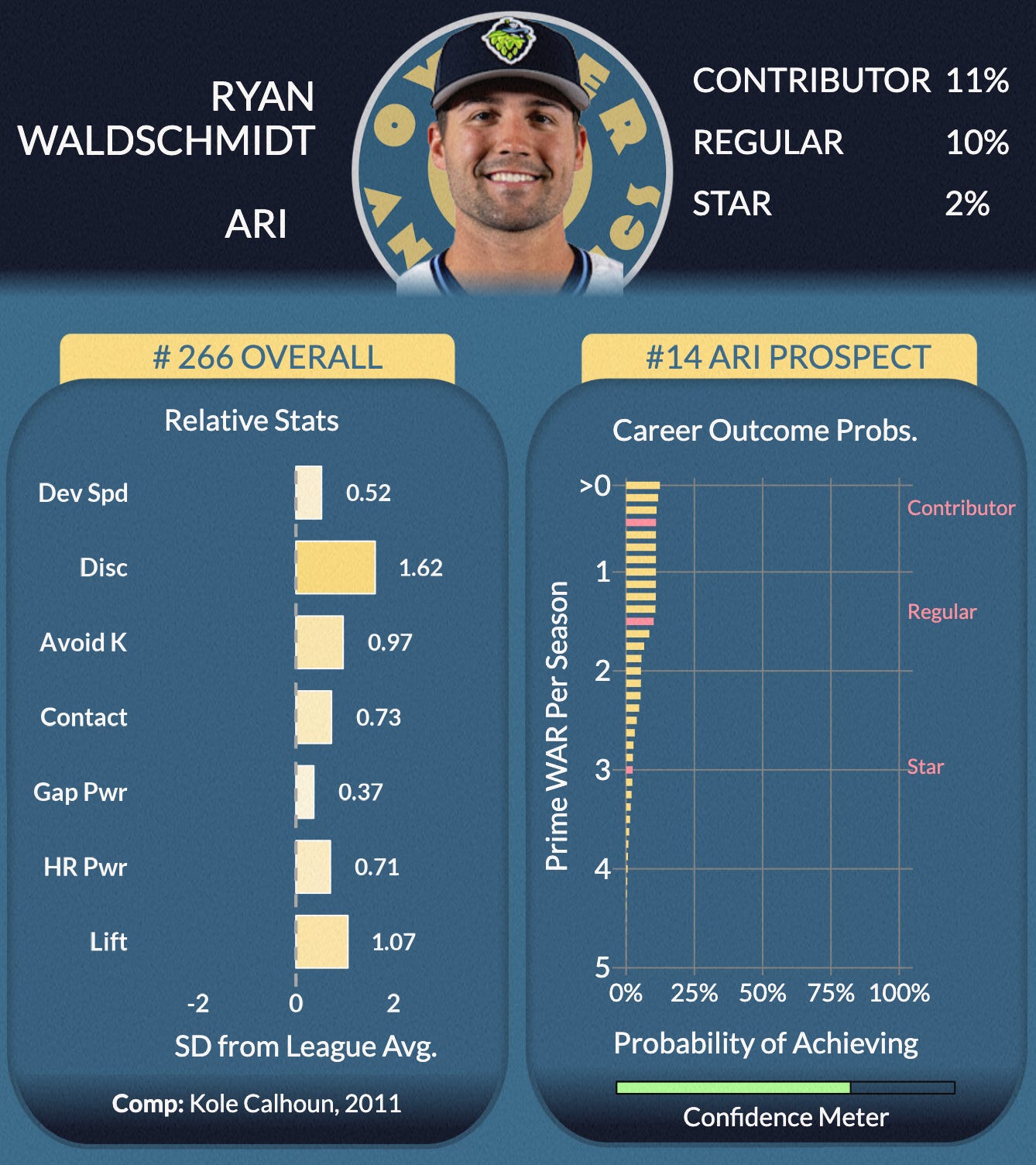
Waldschmidt is an interesting inclusion here because some scouts actually have their own qualms about him based on eye-test scouting. FanGraphs, in their admirably pithy Prospects TLDR writes about Waldschmidt: “Visual evaluation of his max-effort swing indicates his hit tool is riskier than his college stats indicate.” BA expresses some more specific, similar concerns to this in their report on him, and the general tenor is not one of unbridled enthusiasm. Nonetheless, these concerns were not enough to keep Waldschmidt out of the top 50.
The appeal of Waldschmidt is that he does most things well, on both offense and defense. The downside is that he doesn’t do anything exceptionally well and has not done it in particularly challenging contexts. Waldschmidt spent just over half of the year in High-A last year, where he did quite well but was, by serious prospect standards, far from being over-leveled. He then had a good second half in Double-A, but his top-line power numbers were inflated by playing his home games in a very home run-friendly park, and his on-base skills jacked up by a BABIP of .362 that seems likely to come down given Waldschmidt has good but not off-the-charts exit velocities.
Where does reality lie between our bearishness and BA’s bullishness? Well, of course, we’ll say it’s closer to our end. Floor-wise, we’re probably too low on Waldschmidt. He seems like a lock to make some sort of impact in the show, and that is not reflected in our probabilities, which don’t like a 22-year-old spending all that time below Double-A. We think our evaluation of his shot of being an impact regular or star, though, is pretty spot on. As a corner outfielder, this guy has to hit to generate WAR. He’s shown that he’s a good Double-A hitter at a reasonable age, but that’s not the profile of a guy who is a shoo-in to knock the cover off the ball in the show. It could certainly happen, but we stand by our model, which sees it as more of a possibility than a probability.
What Does the Waldschmidt Case Tell Us About Analytics and Scouting?
Our model is rightly extremely concerned with age relative to level, and we think that’s something not always used as enough of a factor in other rankings. That said, being a slow bloomer on its own (or simply joining the league late because you played in college) should not categorically rule you out as a top prospect.
Other Notable Scout Sweethearts, Data Doubts
We like Max Clark (DET) a lot, but not to the extreme extent that BA does—we’re less enthusiastic due to his unremarkable lift and power. Aside from him, the guys in this category tend to be corner outfielders or non-SS infielders who hit well, but often are doing so against similarly mature competition.
The Konnor Griffin in the Room
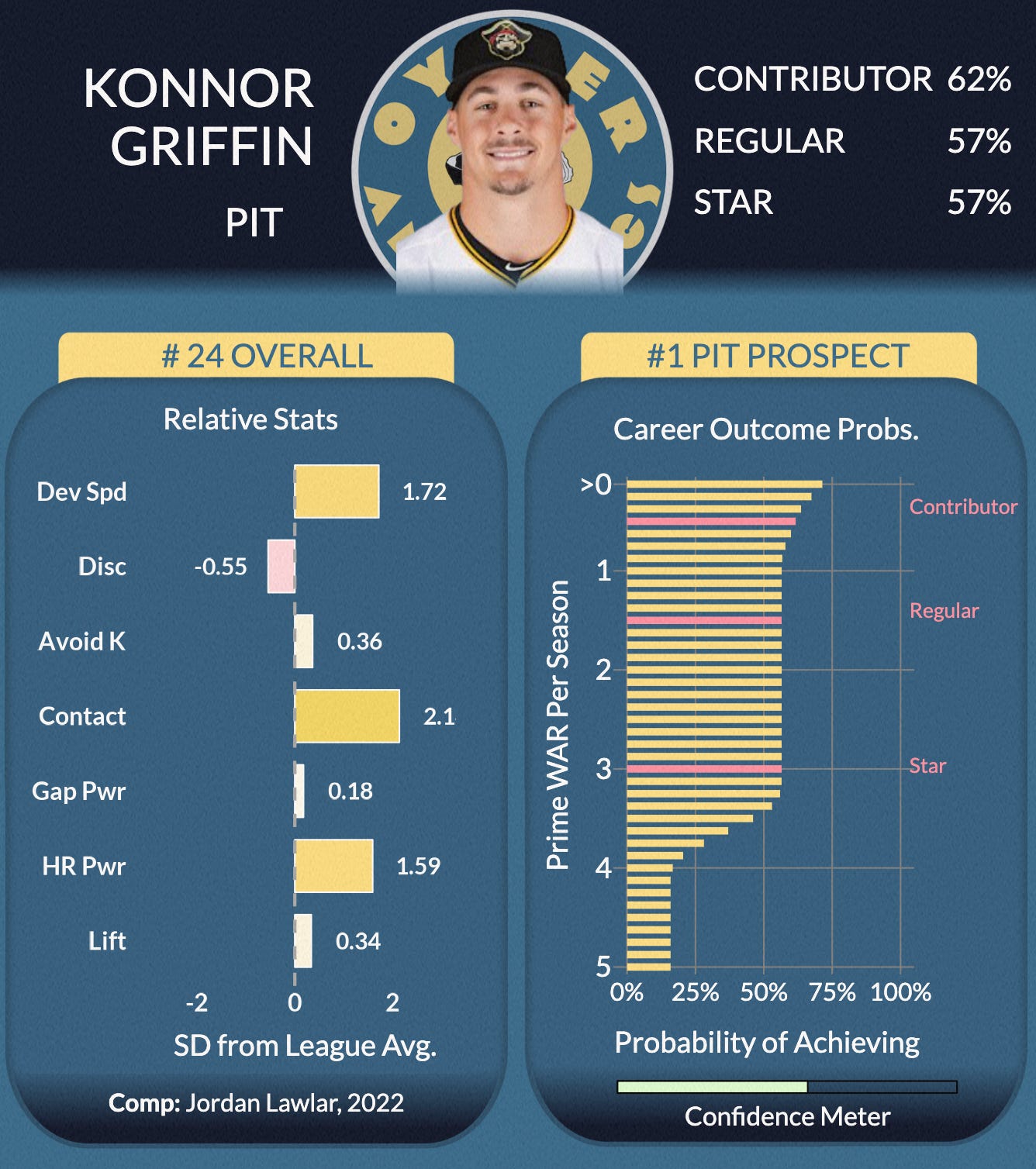
We get it: Baseball America, Fangraphs (2025 updated), and MLB Pipeline (2025 updated) all have Konnor Griffin as their number one prospect. He’s the mythical five-tool guy, and he has the chance to be a plus CF and SS. Why isn’t he our number one?
A few key reasons why:
Our model focuses only on professional, in-game performances and makes no assumptions about raw tools that cannot be parsed from stats. While a lot of Griffin’s deserved hype comes from his numbers, a ton also comes from his raw tool potential, which factors little in our projections. This method finds us some gems, but it can also underrate some toolsy sensations.
Griffin spent most of the season in Single-A and High-A, which is not entirely unprecedented for 19-year-old prospects (Basallo dominated those levels at 18, and so did Emerson). The Double-A performance is what really turned heads, but it was in a relatively short 21-game sample. The baseline productivity alone is a bit less spectacular than how he did it (displaying elite five-tool potential with the physical projection to get even better).
His low walk rate is somewhat of an outlier. While he absolutely spent a ton of time mashing baseballs, he didn’t walk too much (-.55 standard deviations below average). Since 2010, a relatively small number of players had minor league seasons with BB rates that low and gone on to be big WAR earners, with both Martes (Starling and Ketel (ARI)) leading the way among the seven players to hit 20 WAR, and Elly De La Cruz (CIN) the most notable young player on the rise. The De La Cruz comp is interesting, as both players tore up the minors at a young age as SS playing physical juggernauts. Griffin’s current run is more impressive, posting a similar level of dominance at one year younger than the Reds’ franchise player. Which brings us to…
With a random forest model, Griffin may be his own tree. In 2025, playing in Single-A, High-A, and Double-A, he led all teenagers in HR, posted the highest average outside Rookie Ball, had the highest wRC+, stole the second-most bases with elite efficiency, and had the highest HR/FB rate outside the DSL. No player has done these things at this age; he’s like Juan Soto (NYM), but substituting elite discipline and contact for power. In a model that compares his statistical profile to others’ to assess his future, Griffin may be so far from peerless that the technological gods cannot appreciate his good work.
While we do think there’s some risk to Griffin’s walk-unfriendly approach as he reaches the higher levels, even if our model isn’t sold, we’d easily have Griffin in our personal top-5s, if not number one. He certainly has the highest ceiling of any prospect since… Buxton? Harper? For now, our model (and we) will have to deal with the reputational hit of having Griffin at 24 overall.
Wrap Up
While we expected Baseball America to be consistently higher on “toolsy” players and us on more proven (relative to level) talents, there were more exceptions than we expected: we were higher than BA on Clifford and De Vries, two flashy-tooled players, and lower on Bazzana and Waldschmidt, two more balanced, high-floor type players. The comparison also reminded us why we like the guys we like (Young? Just above average but over-leveled? Welcome to the club!) and the types of guys we may be late on because of our de-emphasis of projectable tools. We may take two different approaches, but both BA and we do well in our goal of quantifying and projecting the future of MLB.