
Decoding Prospect Enigmas: What To Really Make of Six Inscrutable Sluggers
We evaluate the MLB upsides of a half dozen prospects whose modeled projections have been volatile and who often divide general opinion


By now, readers will know our pretty detailed thoughts on a lot of our favorite underrated prospects. You know, the Juneiker Cacereses (CLE), Justin Gonzalezes (BOS), Yophery Rodriguezes (BOS), Luis Laras (MIL), and Pedro Ramírezes (CHC) of the world. We’re far enough into strong starts for a bunch of those guys that they’re now also getting more mainstream attention. Most Down on the Farmers will also be well-versed on the Leo De Vrieses (ATH) and Jesús Mades (MIL) of prospect land, who we’ve been going on about for ages, and are also some of the most talked about prospects across the industry.
Today, we want to talk about a different group of prospects: the guys to whom our model has assigned a volatile array of predictions. These are prospects who no one, our model included, seems to know exactly what to make of. In some cases, they’re model newcomers who have only recently cleared our PA threshold and whose projections can leap or dive substantially with a stellar or terrible week. In others, they’re players with unstable profiles or unusual tool sets that make them difficult to project. In every case, they’re players with enough upside to warrant a closer look and a more concerted attempt to understand what they really have to offer.

So, in this piece, we look at three model yo-yoers who have seen their model predictions fluctuate over the past two years, along with three model newcomers who have seen their projections vary in their thus far small samples. We get granular in our evaluations of these players, giving you all you need to know about some of the most exciting hitting prospect enigmas out there today. In several cases, we think we've got some genuine sleepers on our hands whose stock is likely to go up sooner rather than later. In every case, though, risk abounds.
Let’s get into it!
Volatile Newcomers
Taitn Gray (TBR)
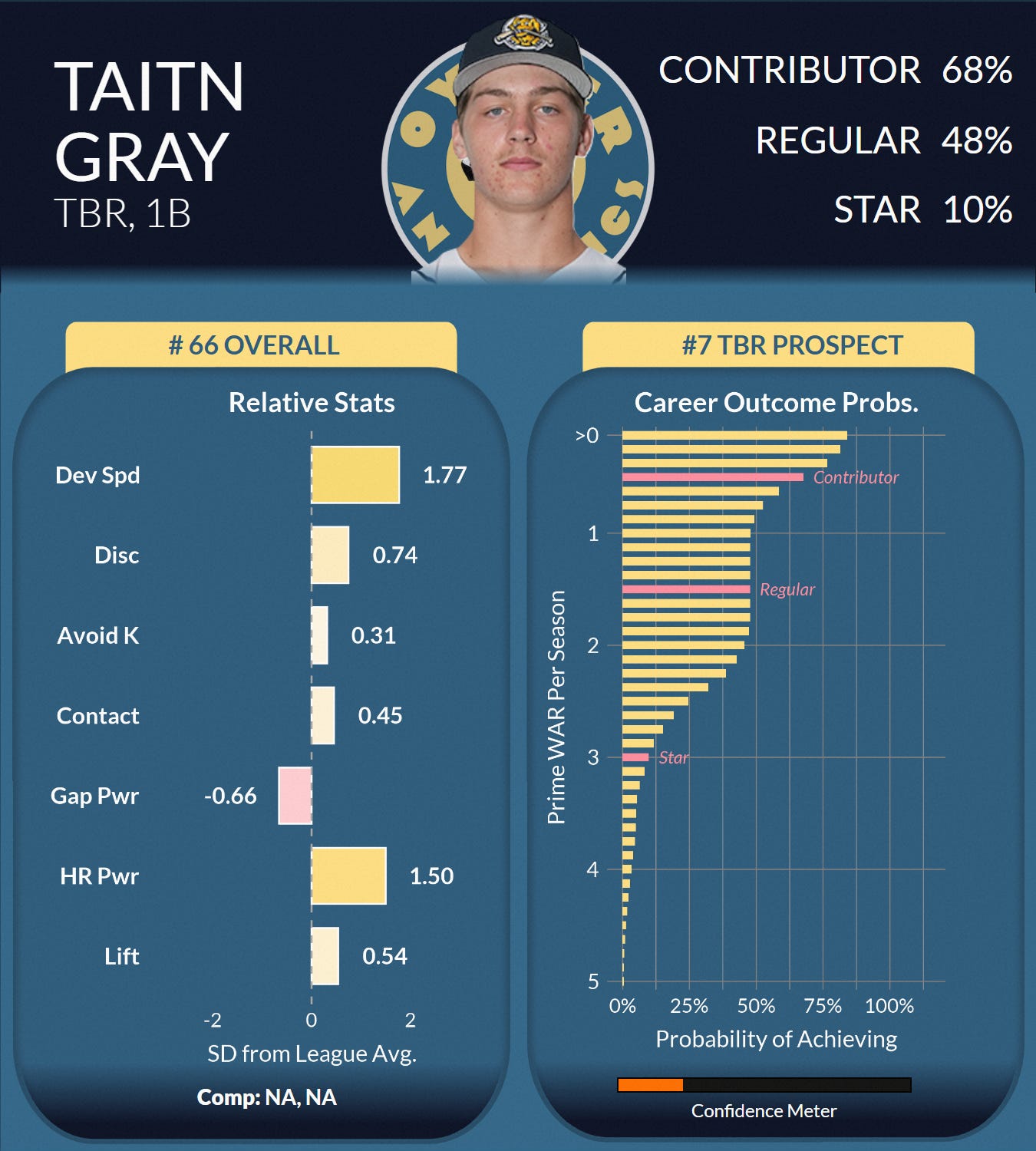
Gray is a big man who often swings really flipping hard when a baseball comes his way. When you watch him take his A+ swing, the word “oomph” immediately springs to mind. He’s got a massive leg kick and a strong two-handed follow-through that, on his largest hacks, he accompanies with a cartoon-esque lean back towards the backstop. See exclusive footage below we’ve obtained of a recent home run of Gray’s:
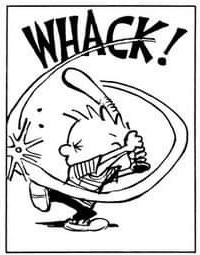
You can’t argue with that form.
Impressively, however, Gray also appears capable of shortening up with a more controlled approach while still driving the baseball back up the middle. I (Owen) was actually pretty shocked by the difference in the first two swings I watched Gray take from the right side of the plate (he’s a switch hitter) in preparation for this article. It doesn’t really show up in a frame-by-frame, and I encourage you to take a look yourself here and here, but you can get a sense of what I mean from a freeze frame of Gray in his follow-through.
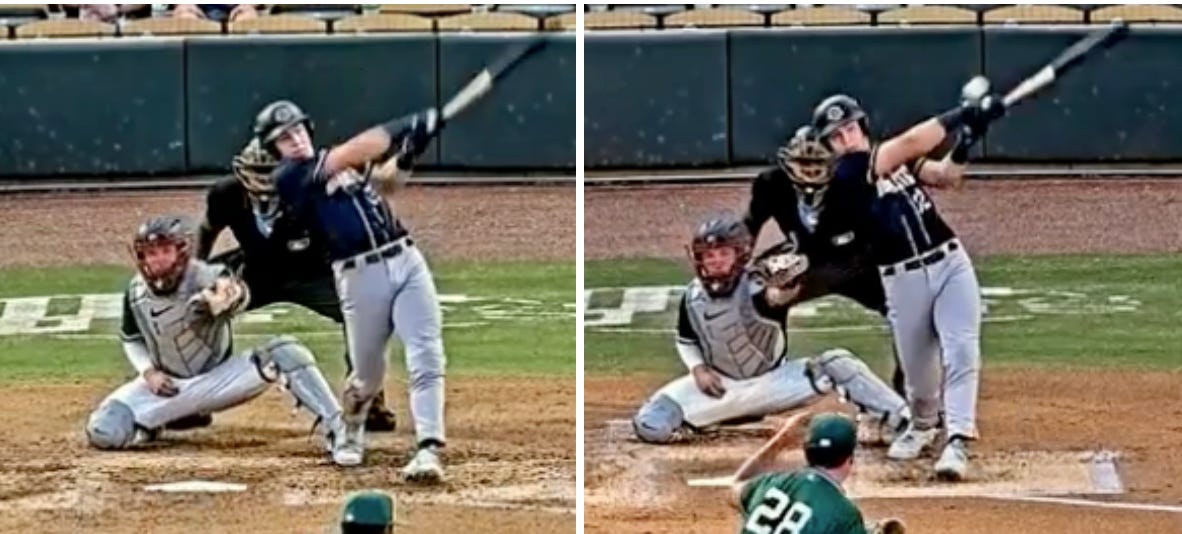
It’s much more obvious in video form, but on the left, Gray has opened his hips quickly and about as far as they can go, kept an unusually large amount of weight on his back side, and swung violently. On the right, his weight is more balanced, his hips are open but not to the same extent (on the left, they’re almost pointing towards third base), and his swing was much more controlled. And, I mean, check out this leg kick:
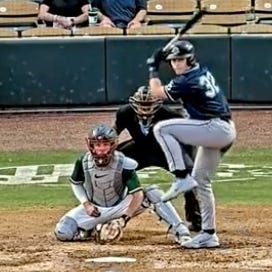
What’s more fun than that?
What we make of this is that Gray is more than his mammoth leg kick and moonshot home-run highlights suggest. When he wants to, he can take his foot slightly off the gas to improve his chances of making quality contact, and he still has enough raw juice to do damage when he does. He’s making contact about 75% of the time right now, but we think that could be higher if he chose to stop selling out for power in hitter’s counts (not that he should).
Given all that, and that he’s 18 in Single-A with a very reasonable 22% K rate, we’re not actually too concerned about the hit tool. This is a hitter who is putting up the numbers our model likes to see (at least enough so that it’s willing to rank a 1B-only within the top 100, a rarity, especially down in Single-A) and who looks adaptable in a way that is promising for his ability to succeed at higher levels. We worry a bit about the leg kick once offspeed becomes a more serious threat, and he starts seeing 60% breakers, but we don’t have any data to back up the idea that that really should be a concern.
We’re in on Gray as a top 100 prospect and agree with the model that he belongs near the bottom of that top century of players. Again, like all the players in this section, don’t be surprised if he yo-yos more in the rankings, since his confidence meter is low and he’s got well under 200 PAs in affiliated ball, all in Single-A this year. Also props to one Bluesky user (who we cannot find) who enthusiastically asked us about Gray over a month ago; you saw it coming!
Luke Stevenson (SEA)
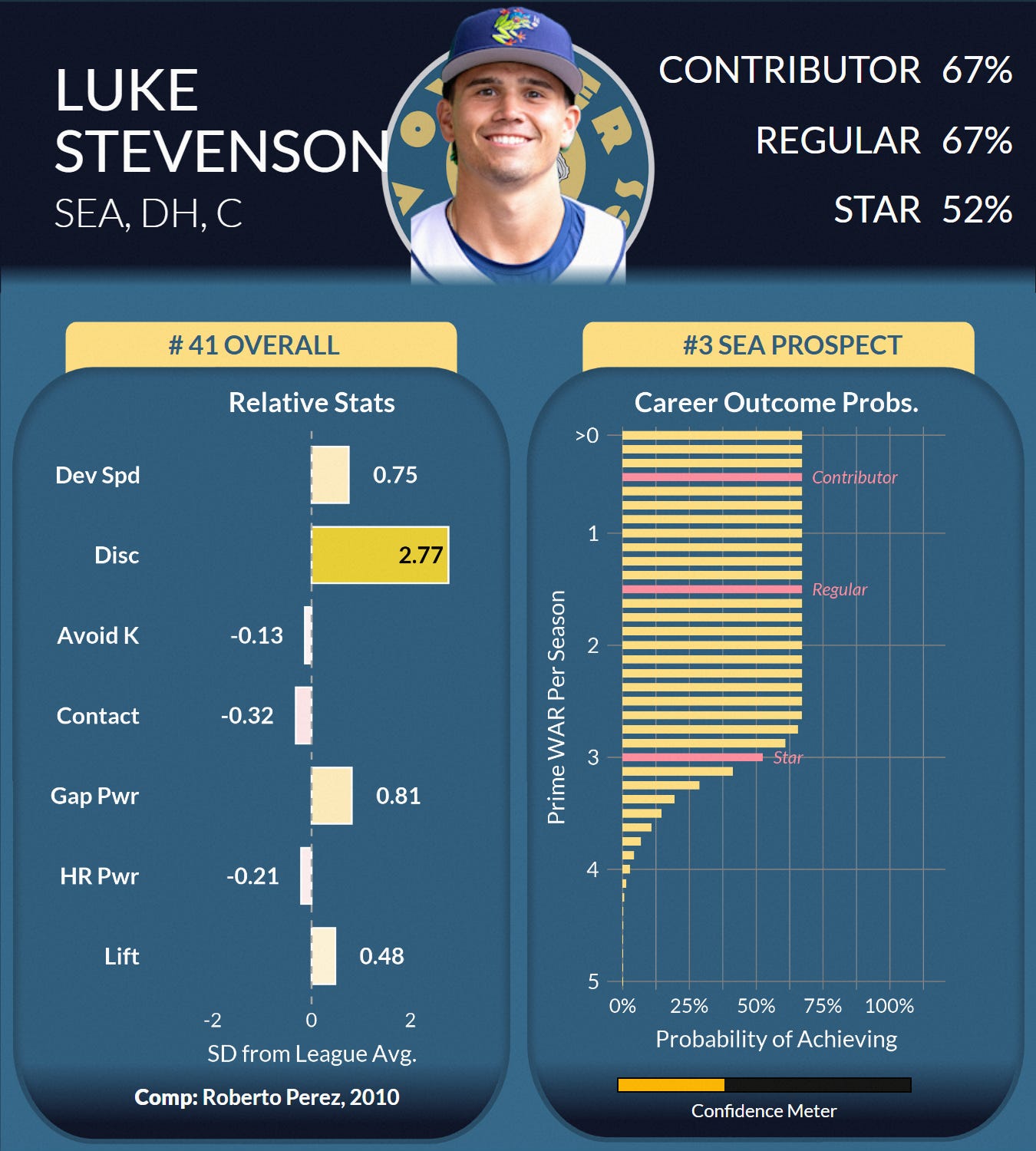
Stevenson is in High-A, and his player archetype is “Window Shopper.” That is often not a good sign, since walks are fairly easy to come by down in those parts. As we mentioned in our recent investigation of Luis Peña's (MIL) and Jesús Made’s (MIL) swing decisions, about a fifth of pitches down there are non-competitive.
And yet, the model has him within our top 40 and earlier this year briefly had him within the top 20! So what gives?
Well, first off, remember that Stevenson’s confidence meter is only about a quarter full, meaning that while we rank him highly, we’re acknowledging how prone that ranking is to fluctuation. Stevenson still has fewer than 250 pro plate appearances under his belt and is three steps from MLB, which means we still don’t know exactly what we’ll get long term from him.
But he’s a catcher, taking some pressure off his bat, and on the offensive side, there are some serious green flags. Stevenson is hitting for a solid average (.265 at the time of writing on May 19th), and nearly half of his hits have been for extra bases. He’s running a very high BABIP, but also a groundball rate under 35% and a pull rate up near 50%, which suggests he’s putting the ball in play with authority at productive launch angles and could run a good BABIP long term.
Our concern with Stevenson is that he looks like he could essentially turn into a three true outcomes player, but he doesn’t appear to have the serious pop necessary to make that work in a way that makes him anything more than an average player. He was a home run machine in college at UNC, but that looks to have been more the result of his consistently productive launch angles and the metal bats than a sign of 60+ grade raw power. We don’t have any EV numbers for Stevenson, but watching him hit, his swing doesn’t have the same whip to it that those of elite power bats tend to have. That’s not a problem in and of itself, but it does put more pressure on the hit tool.
Bottom line, we think Stevenson will probably settle a little lower in our rankings, maybe around 50-60th overall. Given he seems like he’ll be a better-than-average defensive catcher, we think he’s likelier than not to reach the “Regular” threshold, but don’t see many All-Star games in his future. Again, though, very early days!
Louis Andujar (BOS)
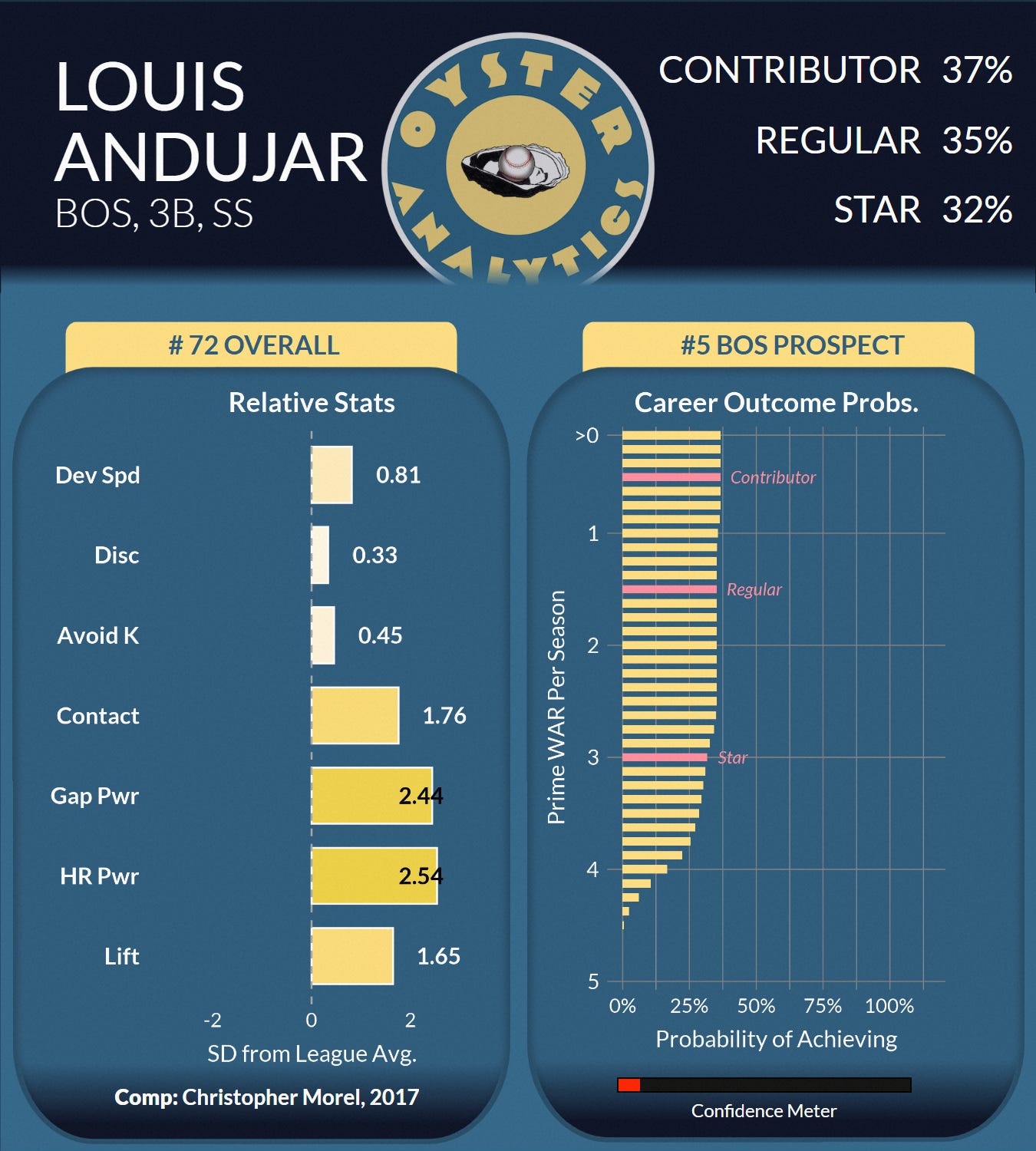
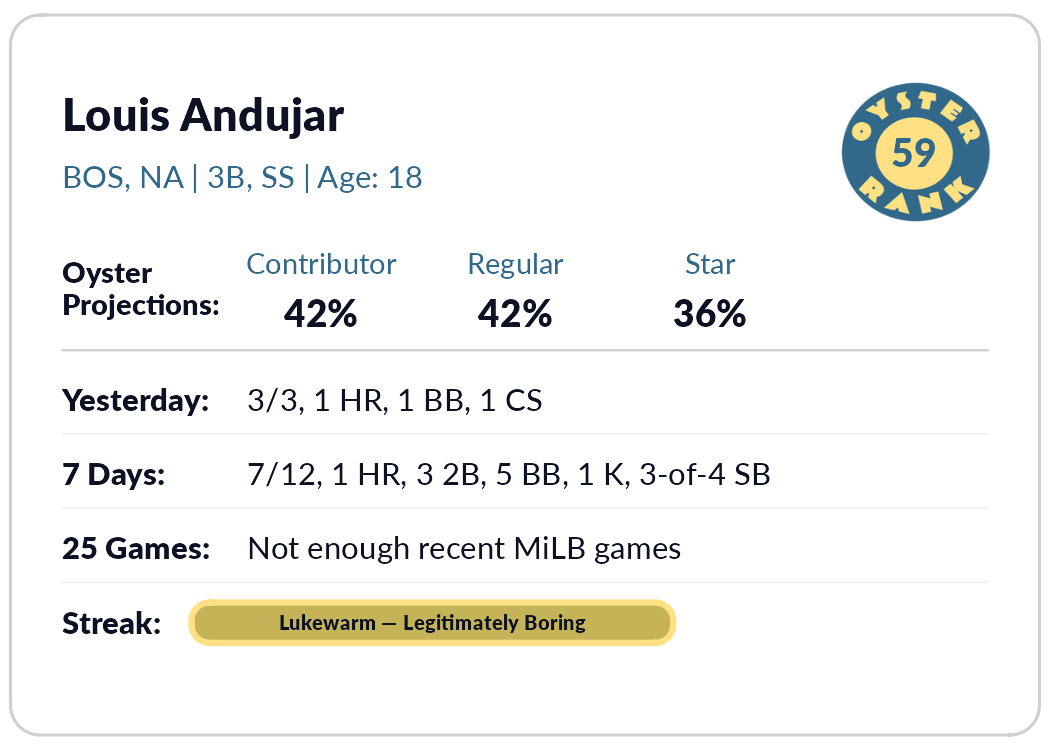
This is one of the more obscure write-ups we have done so far in 2026, and it’s about a player with one of the strangest profiles in affiliated ball right now. Before we get into it, it bears emphasizing: substantially more so than with the other newcomers we’re highlighting here, there is a ton of uncertainty around Andujar. He has yet to play above the complex, is only 18, and has well under 200 professional plate appearances, most of which came in the DSL. His confidence meter is at rock bottom for a reason. That means the bust potential is high, particularly since Andujar is not a plus-plus bat-to-ball guy, but it does not negate the fact that what we’re seeing now is a glimpse of a high ceiling.
Let’s start with the basics, since most people reading this will have never encountered Andujar before. Andujar is sometimes listed as a shortstop, but in reality is a third baseman who occasionally tries his hand at second. He spent his age-17 season in 2025 with the Red Sox in the DSL, where he hit five home runs and posted the 11th-best ISO among players with at least 100 PAs.
Ok, so far, pretty normal.
He also swung only 37% of the time en route to a nearly 20% BB rate.
That’s not that weird; the DSL has a lot of wild pitchers.
Now the kickers: He pulled the ball 72% of the time and hit 44.3% fly balls with a 44.4% infield fly ball rate!
That means that about one in every five balls Andujar hit was an infield pop-up! But it also means that his Pull-Air% (which we don’t have data on in the DSL) must have been absurdly high.
Prior to the season, you might brush some of that off as classic DSL weirdness. You get some weird stat lines down there, and all but the most extreme, contact-heavy performances are pretty useless as predictors of future MLB success. Now, however, we’re a couple of weeks into Andujar’s stateside career, and things are still looking really bizarre and promising. We’re writing this on May 19th, 11 games into Andujar’s 2026 campaign, and so far he has hit precisely one ball to the opposite field. One. In 45 plate appearances. His ground ball rate is also a ridiculous 10%, by far the lowest in the league. He has also dramatically lowered his infield fly ball rate to 20%.
In other words, so far this season, Andujar is continuing the good stuff from his DSL stint and addressing his flaws. His walk rate has predictably fallen, but encouragingly, his strikeout rate has not budged much. So far, it’s all coming together for him: he’s riding a 192 wRC+ at the time of writing.
This has all been enough to bump Andujar up into the top 100 of our model and earn him a roughly one in three chance of reaching our “Regular” threshold (peak of at least 1.5 WAR per season for at least three seasons). When you look at his player dashboard on our site, you can see why. Every trait for Andujar is at least 0.5 standard deviations better than his average peer’s, while four–contact, gap power, home run power, and lift are more than 1.8 SDs better than average. That translates into 90th-plus percentile power and lift rates for a guy who is also better than league average in the contact and discipline department. If even an approximation of that continues through the season, we’re looking at a very serious prospect here.
That, of course, is a big if. Traits like home run and gap power are not all that sticky or predictive on their own in the Complex, but Andujar is doing everything he can to prove the power is there to stay. He’s clearly got the strength to clear the fence, and he’s hitting the ball at trajectories that max out his chances of doing so. The big test will be whether the hit tool survives once he sees A-ball pitching. His contact rates so far this year have been good-not-great at 78%, so it’s difficult to say what lies in store once he is likely bumped up to the Salem squad later this season. The upside, though, is certainly there, and a lot less has to go right from here for Andujar than it does for most guys in his position for them to see future success. He’s probably going to yo-yo some more in our rankings as his performance fluctuates and inevitably regresses a bit, but he is a guy who could easily be cracking top 100 lists within the next two months.
Model Yo-Yoers
Jason Schiavone (HOU)
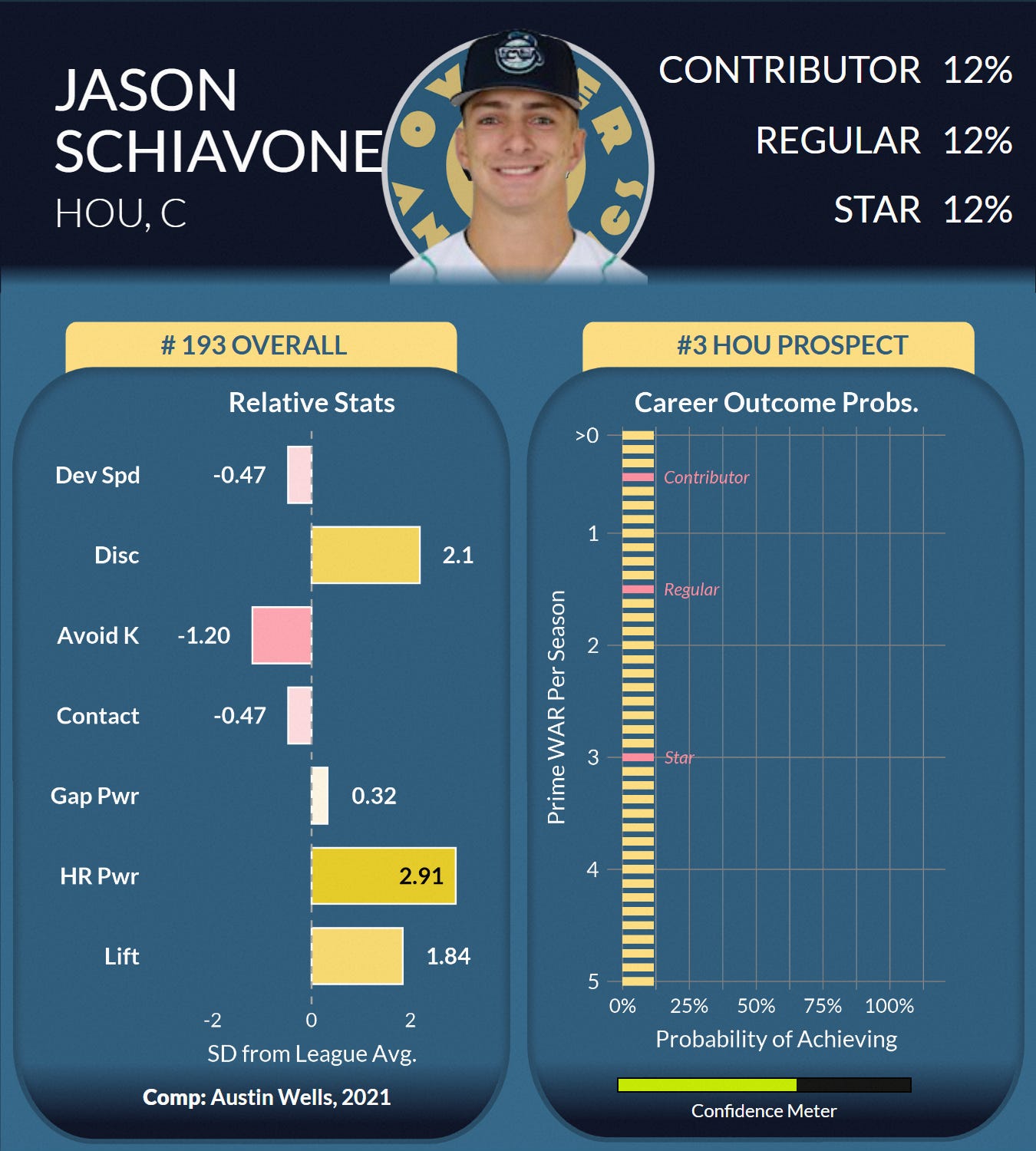
Schiavone is a model rarity: he started the season with our model’s lowest standard (0.1% contributor, < 0.1% regular and star) and now has a 1/10 shot of being a star. His identical 9% spread across all three categories fits his profile, as he’s a far older-than-average high-strikeout guy with monster power, currently leading the minors in homers with 18 in 172 PA. Last season gave almost no indication that this pop was in the tank, as he only hit six home runs in 300 PA as a 22-year-old.
Looking at his swing, it seems clear that he’s selling out for more power in 2026 (2025 on the left and center, 2026 on the right):
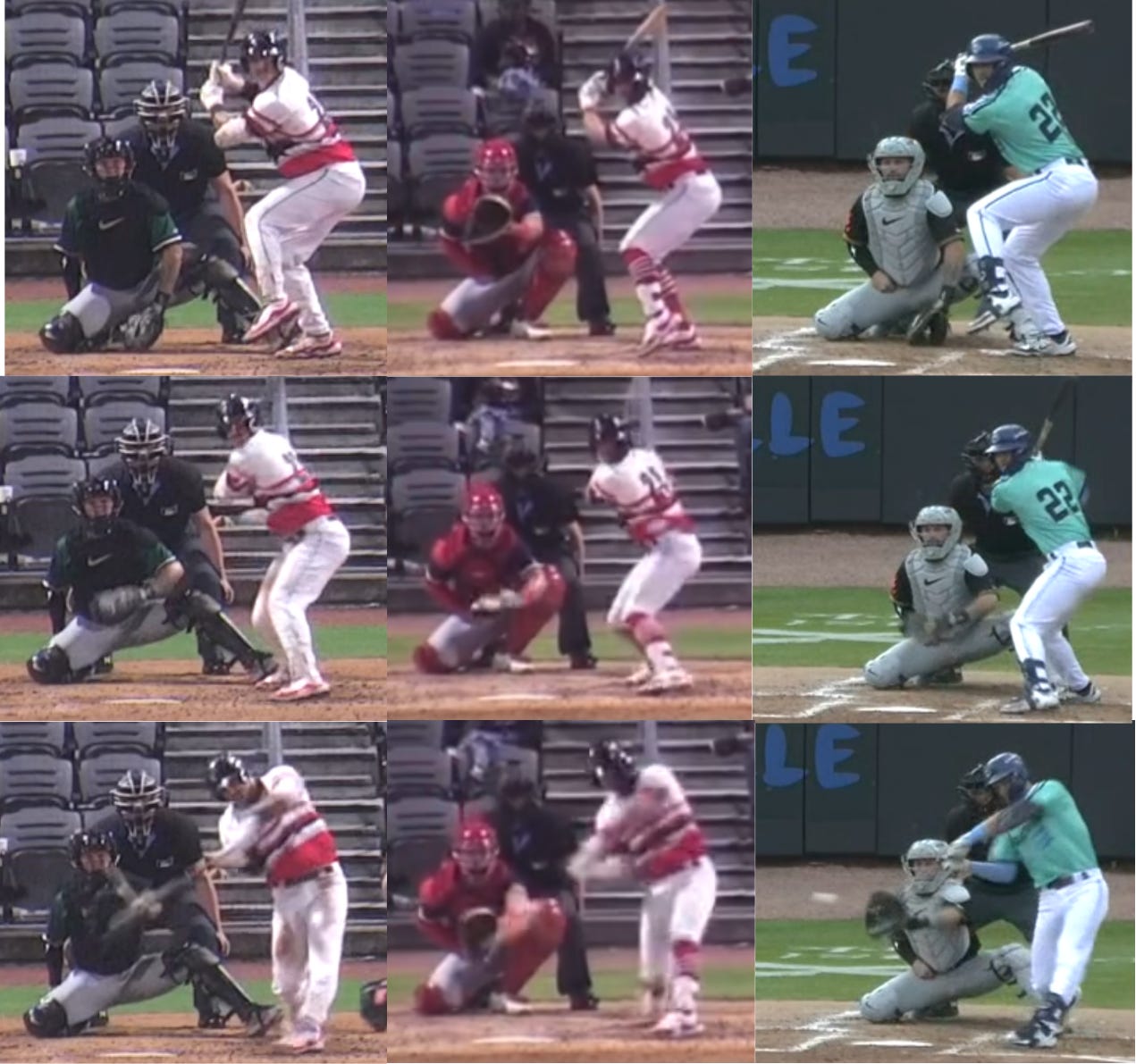
He converted from a toe tap or a smaller leg kick to a more exaggerated leg kick, and while he does well at opening the hips in both seasons, his 2026 finish looks a touch more violent. These pitches resulted in opposite-field homers, which isn’t a rarity for Schiavone, who goes oppo almost as much as he pulls.
Despite numerous contact red flags (contact rate at 62.5%, K-rate at 30.9%), he’s optimized his profile this season, cutting his ground ball rate below 30%, with fly balls making up nearly half of his contact, around 10 percentage points higher than his 2025 rate. This lift, in conjunction with a real surge in power, gives Schiavone a homer in around every ten trips to the plate, an elite (and probably unsustainable) rate. Even though the hit tool projects poorly, he does a fantastic job of getting on base, walking in 22.7% of his PA. It’s difficult to project this early whether someone will be a good high-level walker, but with clear power upside, he has a chance to make it stick.
Exceptional traits make exceptional prospects, and Schiavone’s power earned him a promotion to Double-A. This is a more age-appropriate level for the slugger, who will now have to grapple with better and more accurate stuff. To succeed, he’ll need to find one of these three niches:
Effectively eliminate all chase, ride the BB and power to overcome poor contact %
Up the contact % enough to cover the likely drop in BB, hit bombs
Be a scary enough HR threat that he still sees BB, contact holds true
For a player with contact as low as Schiavone’s, he cannot afford any of the typical contact drops that come with a rise in competition. Regardless, hitting bombs always plays, and if he continues his development, he could start to get serious consideration as an MLB-level guy.
Clearly, we aren’t ready to sell the farm for Schiavone, but if he does well post promotion, we may see him enter mainstream prospect rankings (he was outside FanGraphs’ preseason top 30 Astros rankings, a thin farm). He’s our second-ranked Astros hitter (who has met our 100 PA threshold), just ahead of another very similar power-bat catcher in Will Bush.
Braylon Payne (MIL)
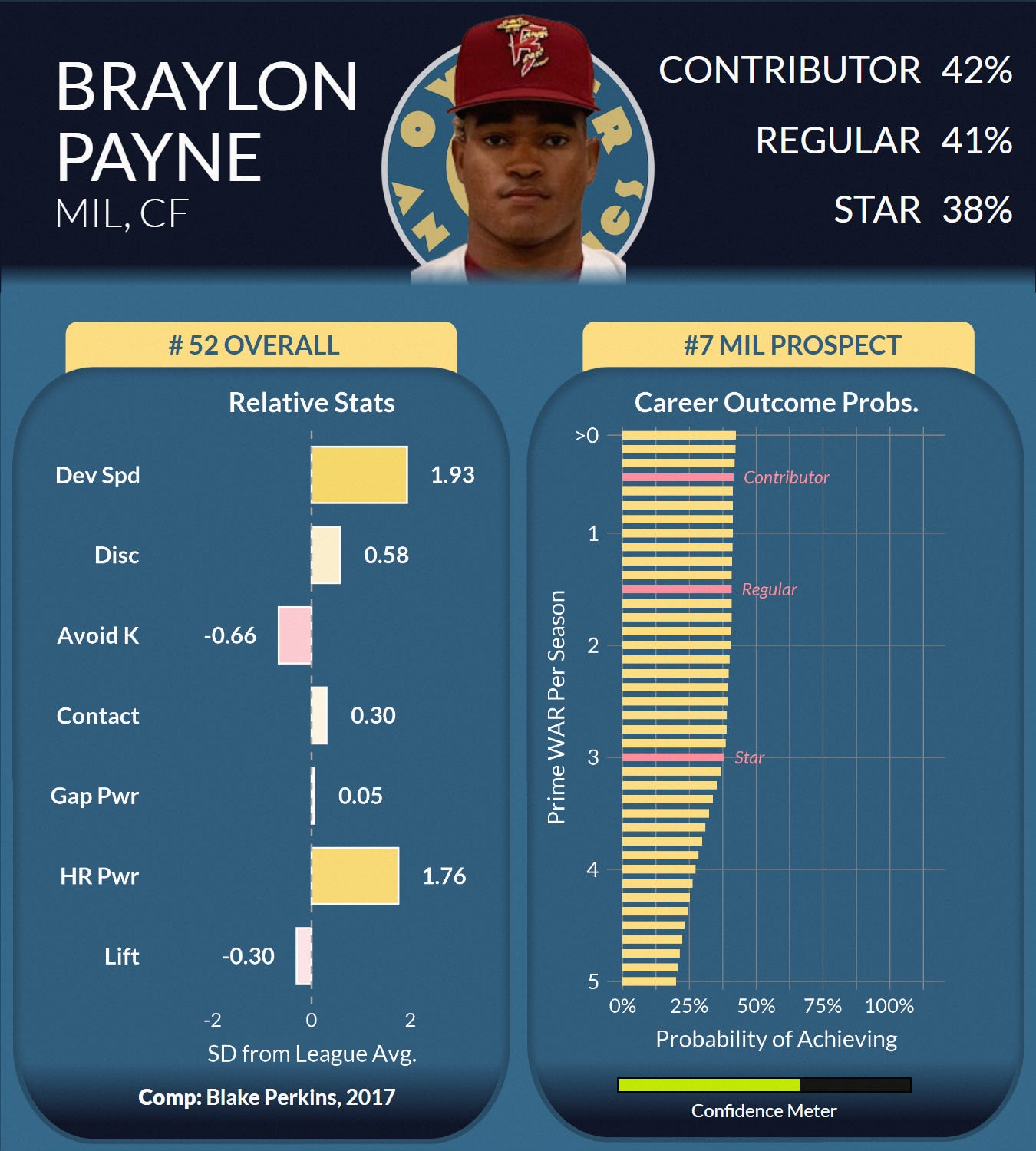
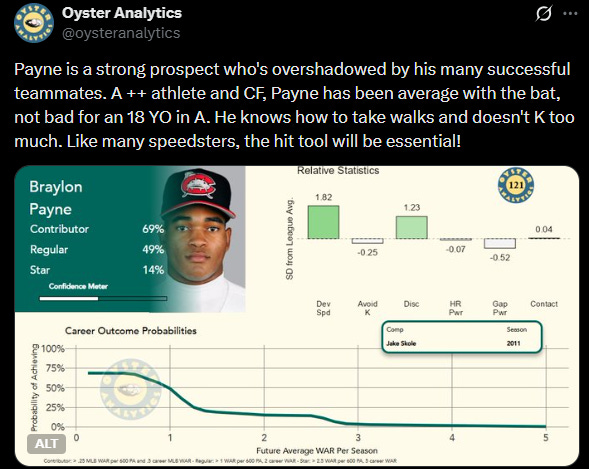
Payne is perhaps our highest-profile yo-yoer. He broke into our top 50 early in his 2025 season, but swiftly fell outside of our top 100 as the season went on, and his strikeout rate rose above 30%. We had him at 121 in July of last season:
Despite mixed results in his first full season in High-A, the Brewers promoted Payne to High-A, where he’s been scorching hot in his first 130+ plate appearances. He’s improved nearly every facet of his game, cutting the Ks down, slightly improving contact, slashing his over 50% ground ball rate to just over 40%, and doubling his HR/FB%. Unlike most speedsters, Payne is certainly a power-first player who has the power/walks combo that is more common with looming first basemen.
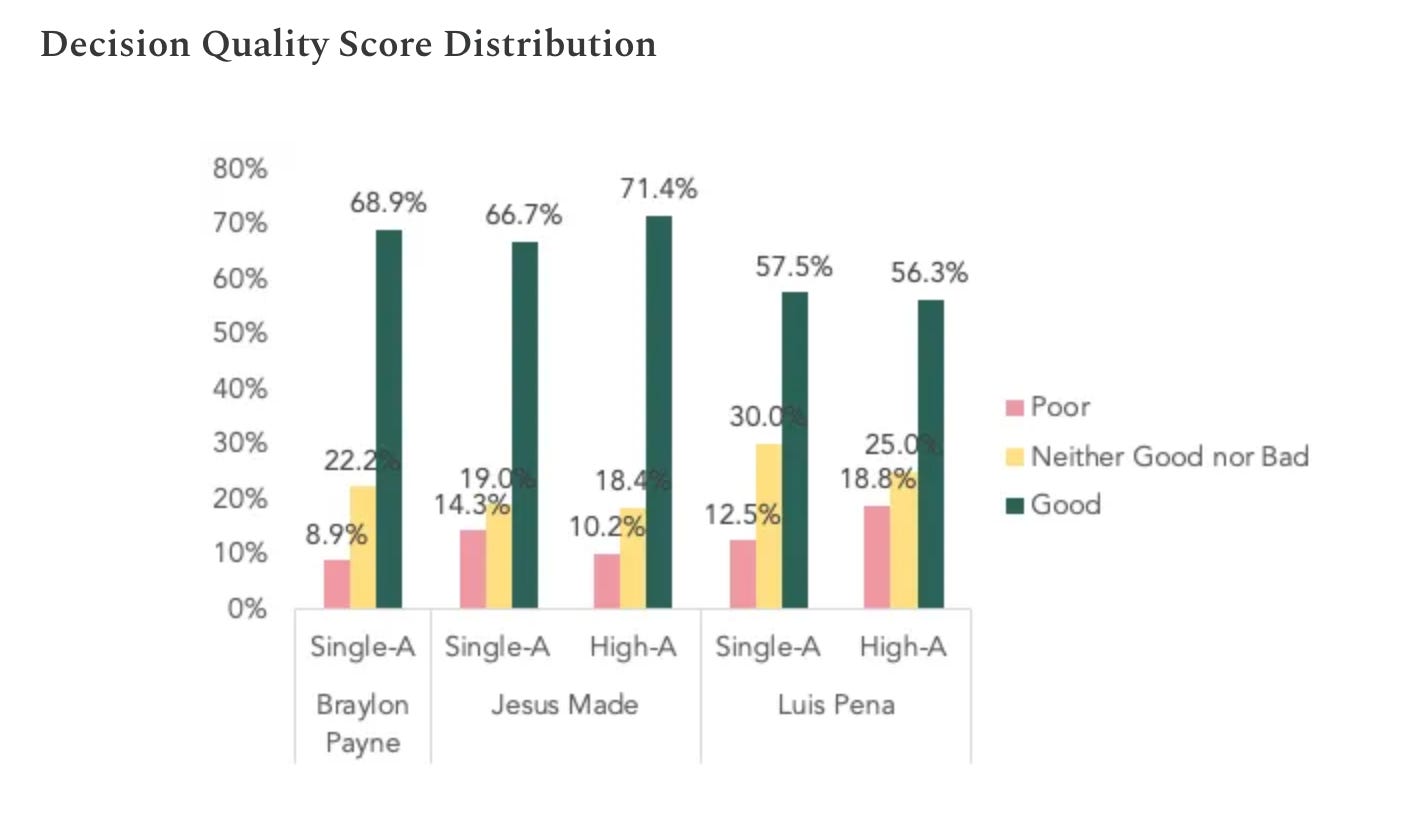
He already has 10 homers this season, eclipsing last year’s total of eight in over 200 fewer PA. Payne’s improved contact quality is also upping his average; he’s hitting .275 this season after hitting .240 in 2025 despite posting a lower BABIP thus far in 2026. Part of this rise is likely due to Payne’s improved “swing confidence,” a term we coined in a recent research article to describe how often a hitter gets off their “A-swing.” While Payne fared worse than Single-A Brewers peers Jesús Made and Luis Peña in terms of overall productivity, Payne’s swing decisions in our five-game sample were on par with the duo:
But Payne got off his best swing far less frequently than the two starlets:
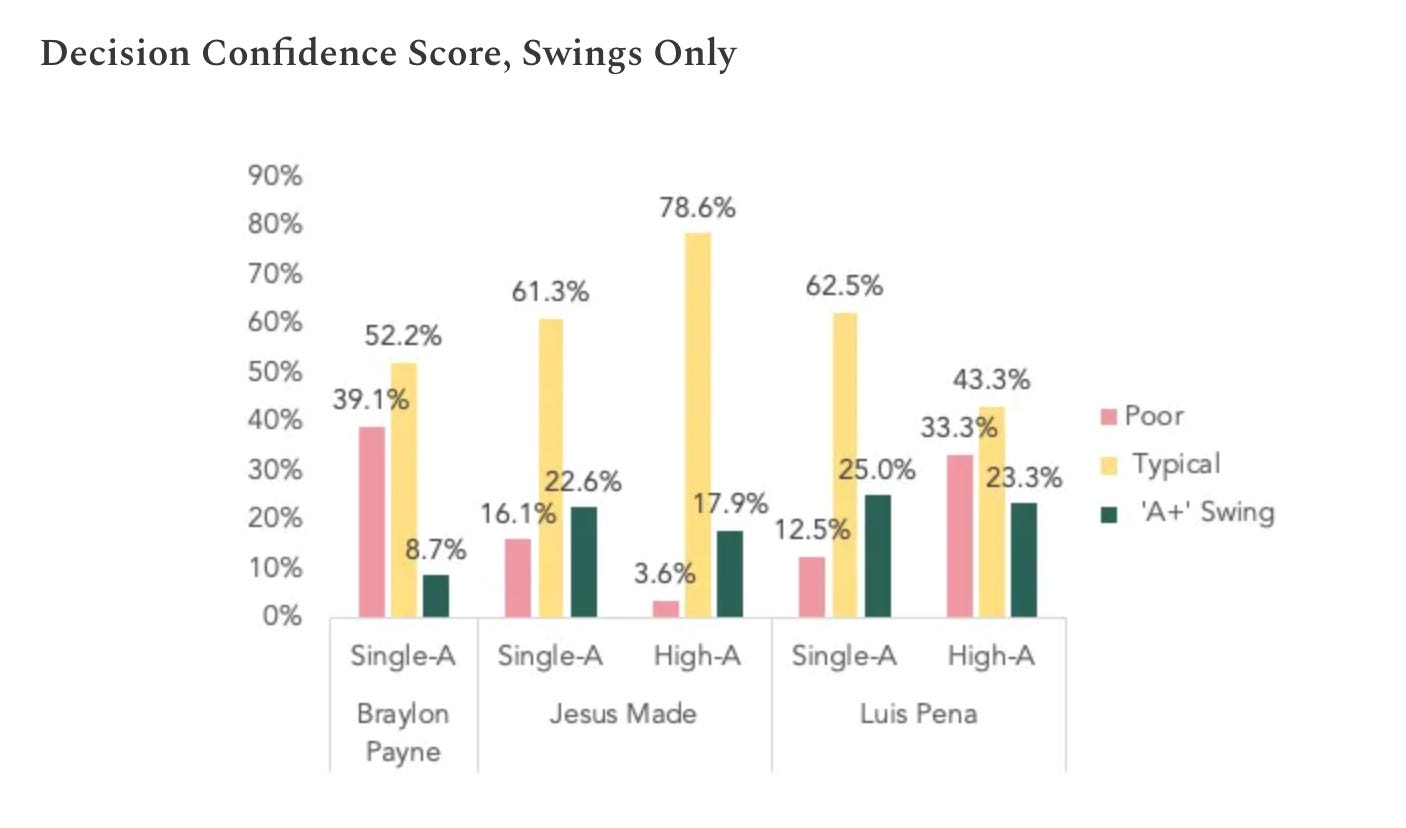
For us, it’s not surprising that Payne’s contact quality has gotten so much better without contact rate improvements, as our work indicates that he had trouble making his best swings and fully maximizing his high-EV potential. He’s certainly not getting cheated too often this season, and while his contact metrics still aren’t fantastic, it’s a real boon that his power surge hasn’t coincided with a whiff increase.
In an adjustment befitting his performance, Payne has shot up our rankings, cracking the top 100 and improving his star percentage from 1.6% to 34.1%. While some pop increases are flashes in the pan, Payne’s improved launch and across-the-board hitting improvement have convinced our model that this growth is legit. Our model also continues to appreciate his work in centerfield. He’s an extremely quick player, but needs more seasoning to turn the pace into a plus glove and base-stealing prowess. His high fielding ceiling gives us another reason to buy the hype.
Blake Mitchell (KCR)
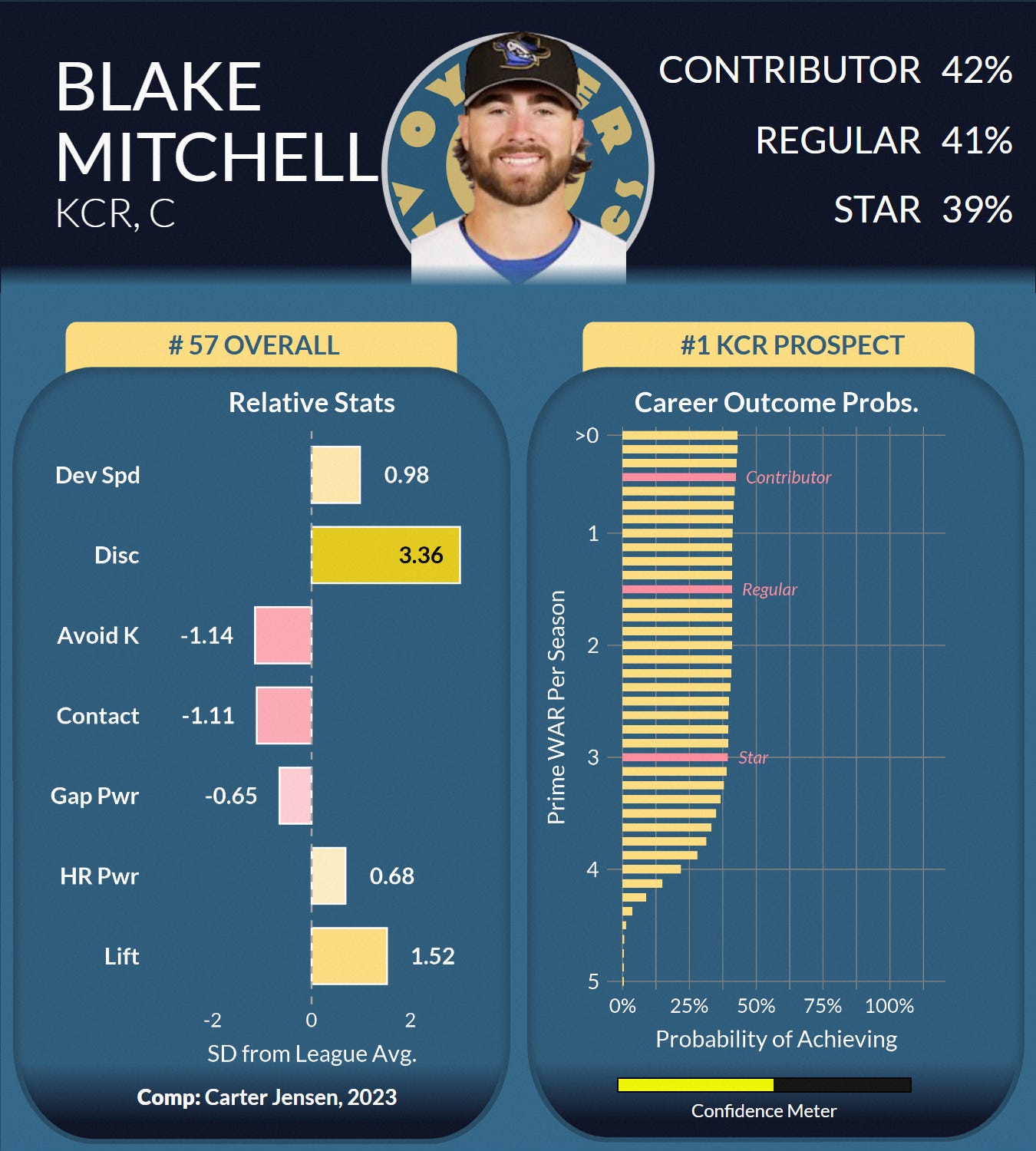
Before last season, Mitchell received high-level prospect buzz, with both Baseball America and MLB Pipeline ranking him in the top 100, with Pipeline placing him at 48th overall. We thought these predictions were overly aggressive, writing this in the “too hot” section of our Goldilocks-themed prospects article in June 2025:
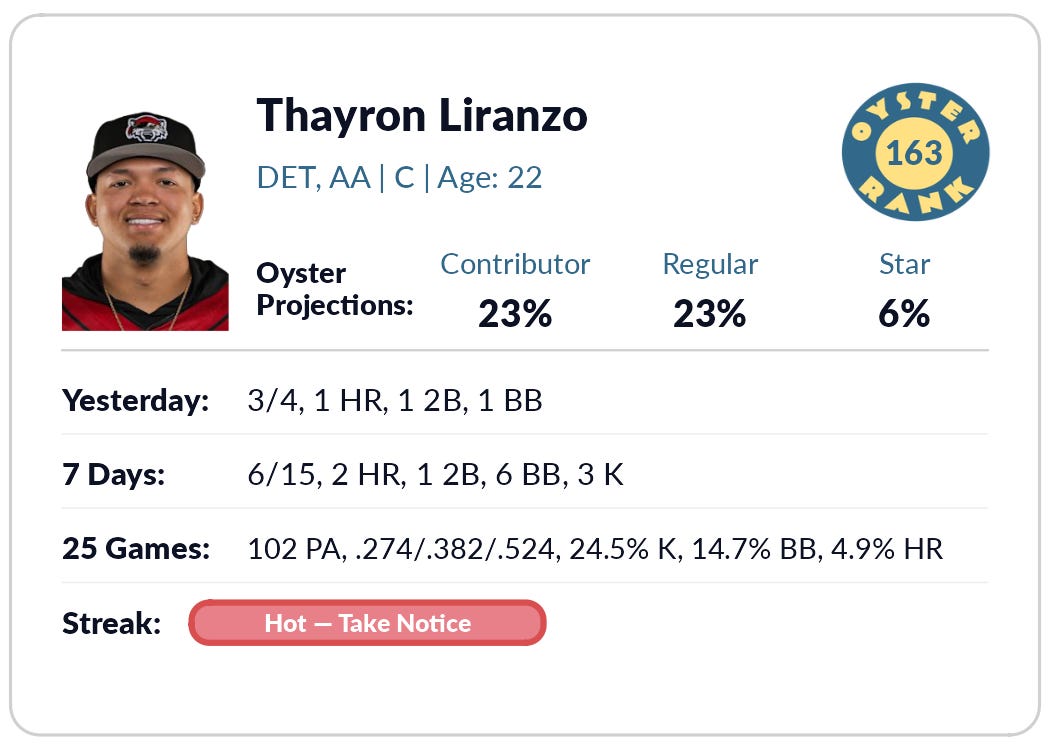
While he did hit for big power, he only posted a .238 average, with much of his .376 OBP coming off of walks. With walks being relatively easy to come by in the low minors, a good walk rate is less impressive if the hit tool is not also a plus trait. In addition, a 30.5% A-Ball K-rate is a scary high figure, and a 20+% infield fly ball percentage hints further at hit tool struggles. For reference, Thayron Liranzo (mentioned earlier, and a similar HR mashing C prospect) had a 26.8% K-rate and hit .272 in his 19-year-old season in A-Ball. That difference in K-rate and contact is enough for our model to rate Liranzo higher than most outlets, and Mitchell outside of our top 100.
We agree far more with Fangraphs’ 30 grade on Mitchell’s hit tool, and see him more as a boom-or-bust type bat than a solid hitter with pop. Mitchell has had an injury-marred start to 2025, but we’re intrigued to see if he can improve the hit tool going forward.
Mitchell performed to our criticisms in 2025 by riding a big walk rate to a 111 wRC+, but struck out in 31.8% of his PA and hit only three homers. The power drop wasn’t entirely out of nowhere, as he sustained an infamous power-sapping hamate injury during Spring Training. After the down year, most outlets were out on Mitchell, but MLB Pipeline remained loyal, only docking him to the #75 spot. Pipeline scouts rejoice, as this season, Mitchell has rediscovered the power that made him special: he’s got seven homers in his first 152 PA, more than doubling last year’s total. However, if our model didn’t buy 18 HR Mitchell after 2024, but buys this older version, what else shifted?
The primary answer is Mitchell’s walk rate. Mitchell has the fourth-highest walk rate in the minors (min. 100 PA) with a batty 27.6% BB%, a rate three full standard deviations better than his peers. This is an elite rate, and while flashing good discipline isn’t all that rare in High-A, the scale of his patience is truly standout. Additionally, Mitchell has further optimized his lift profile, moderately decreasing his ground balls while cutting his infield fly ball rate in half, giving him more big fly opportunities. Our model tends to favor contact-oriented players, but remains a believer in power-hungry swing-and-missers if they either lift the ball and/or walk at a high level. Mitchell does both, and as such, our model is in when others have fled the scene.
Funnily enough, Mitchell’s closest comparative season with a positive WAR producer is with fellow Royal Carter Jensen, who put up a high walk 2023 season in High-A, where he was worse statistically than Mitchell is now. Still, Jensen was two years younger at the time and had a much better contact rate, giving him a clearer path to MLB viability. In a weird coincidence, Mitchell’s closest other comparable season is Jason Schiavone’s 2025 campaign, where he was less effective than Mitchell getting to his power, but walked a ton. I’d place Mitchell somewhat in the middle of these two players. He’s given more hints than Schiavone (at a younger age) that he’ll be able to carry his strong traits up the chain (especially at C), but he lacks the more complete approach of Jensen that made him a premier prospect.
One area where Mitchell likely has both comps beat is behind the plate. He showed off a plus arm last season, nabbing 18 of 58 base stealers, but hasn’t been as effective this season, catching only 4 of 25 thieves. We trust the in-person scouting reports on this one, as inexperienced and often aloof minor league pitchers can often create issues for catchers (look at Samuel Basallo’s bad CS numbers in the minors last season vs. his elite MLB numbers). Mitchell is also a good receiver and offers clear MLB starter potential in the field, lessening the pressure on his bat.
Mitchell has the Joey Gallo profile, and like Gallo (but unlike other players who are often compared to Gallo), Mitchell has genuine positional upside. He’ll have to grapple with Jensen for playing time if Mitchell continues to rise, but we buy the high-risk profile! If I were a team without a clear young number one catcher, I’d target Mitchell for a trade. Perhaps the Royals would be willing to part with him in exchange for a more positionally suitable prospect.
Wrap Up
While some prognosticating platforms force players to pay their dues before cracking the top 100, or use in-person scouting to give players more static rankings, our model-based approach puts players exactly where it thinks they should be once they hit our minimum sample size. As we said in the intro, this method can cause significant shifts in rank and projection after a good or bad week for players who have recently entered our system. So what’s the best way to interpret this nuance? Look at our confidence scores (located in the bottom right)!
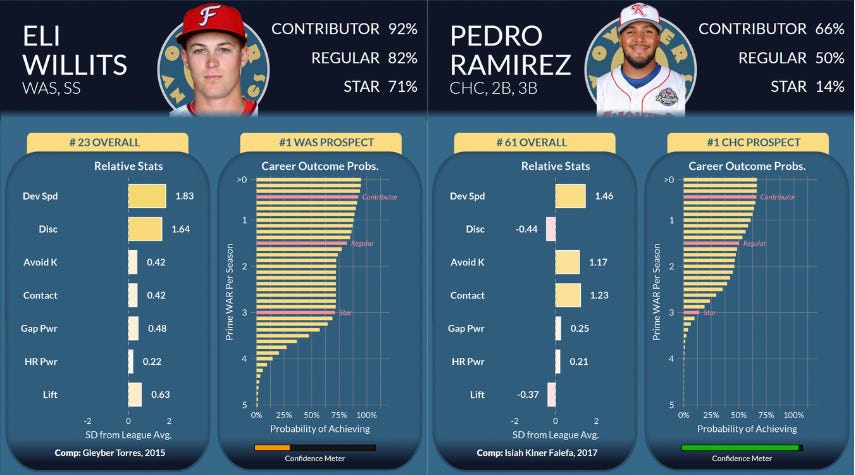
For a player like Pedro Ramírez with several seasons of work at both low and high levels, his confidence meter is nearly full, indicating that he’s a lower volatility projection. Obviously, good and bad performances can shift these projections (Ramírez has moved +10 percentage points in each category this year), but players like Ramírez are less prone to the yo-yo effect when compared to Eli Willits, who has a low confidence meter because of his small sample size.
Look at the pair’s outcomes over time this season to see the difference in variance:
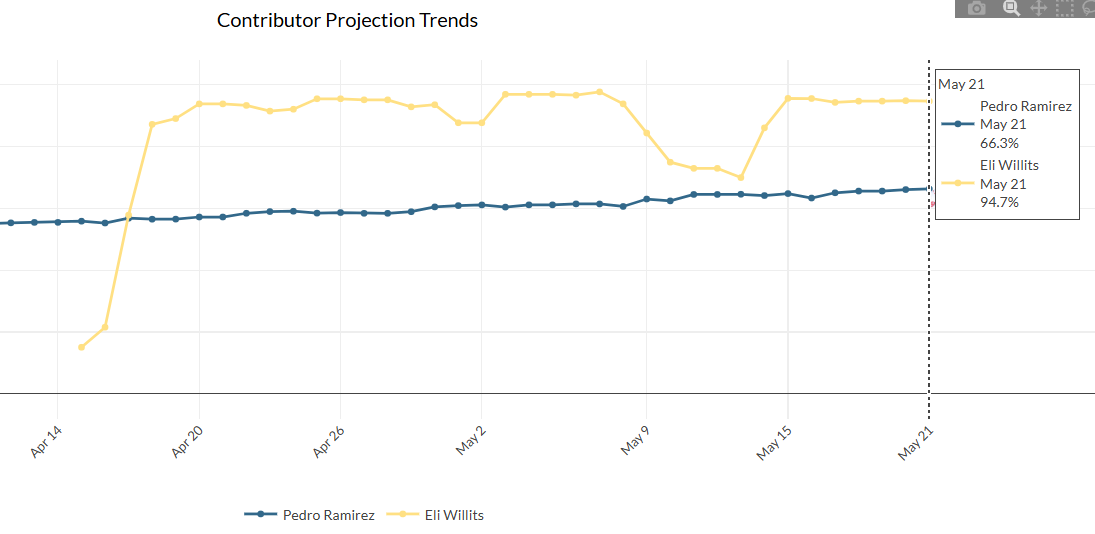
So when you’re on our website and see a prediction, peek at the confidence score to see how sure we are of our analysis. If they have high confidence, it’ll take more than a few good games to move the needle. If confidence is low, they could shoot up or down with a smaller body of work.
Thanks for reading! Which newly-modeled prospect are you highest on?
Pearls of the Day
Which prospects lit up MiLB yesterday?
Best of the Best
Top three performers in the Oyster top 100
Gold Pearl
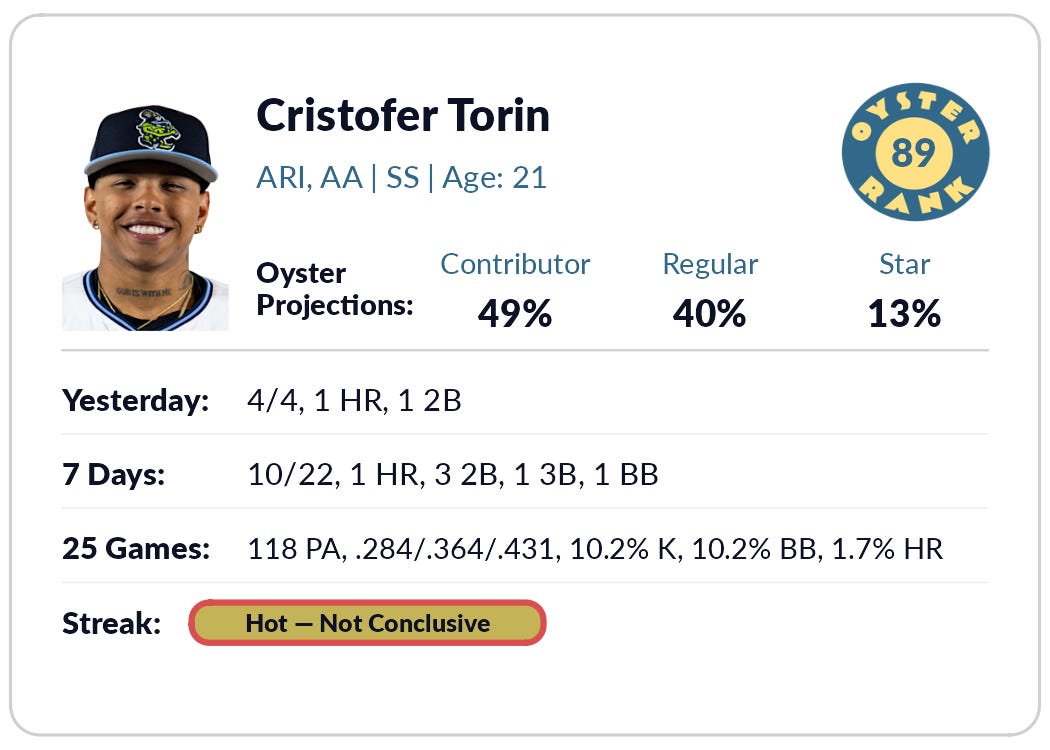
Silver Pearl
Bronze Pearl
Others of Note
The top three other performances in the Oyster top 250
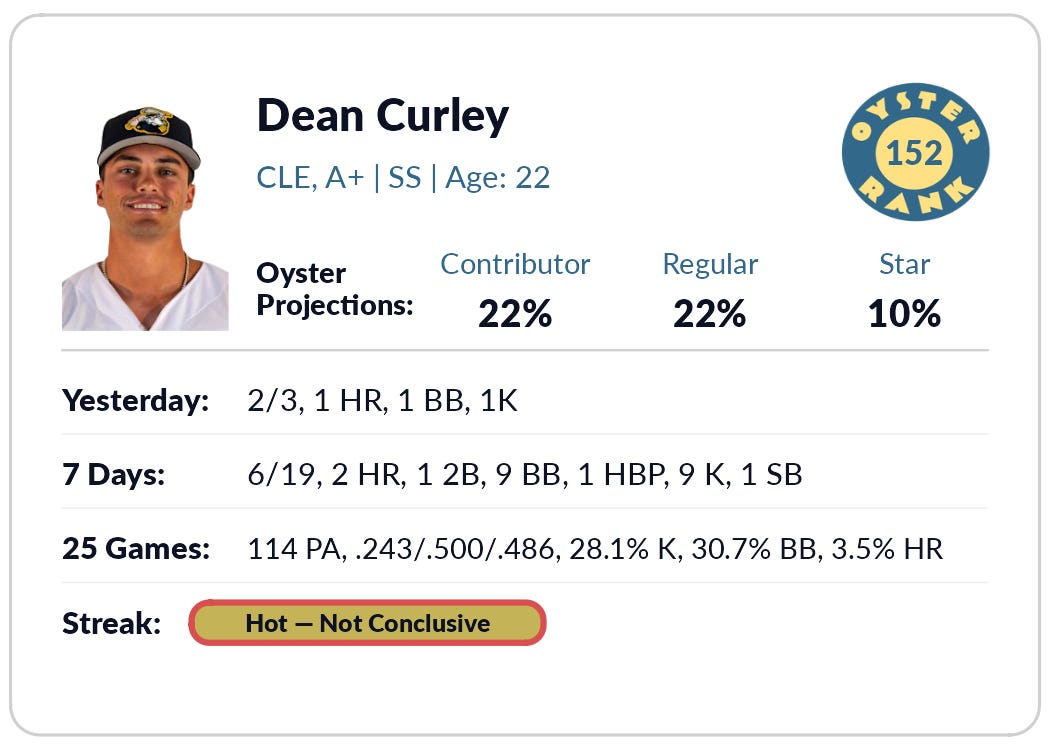
Top AAA Performers This Week
The best Triple-A hitters from the last seven days
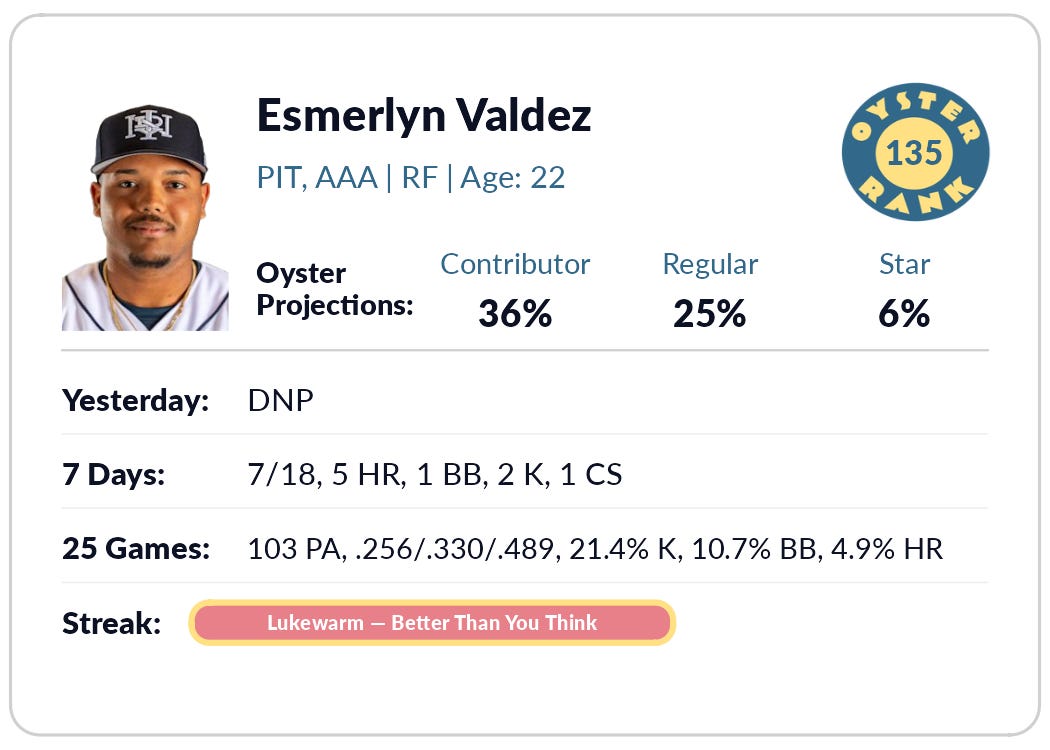
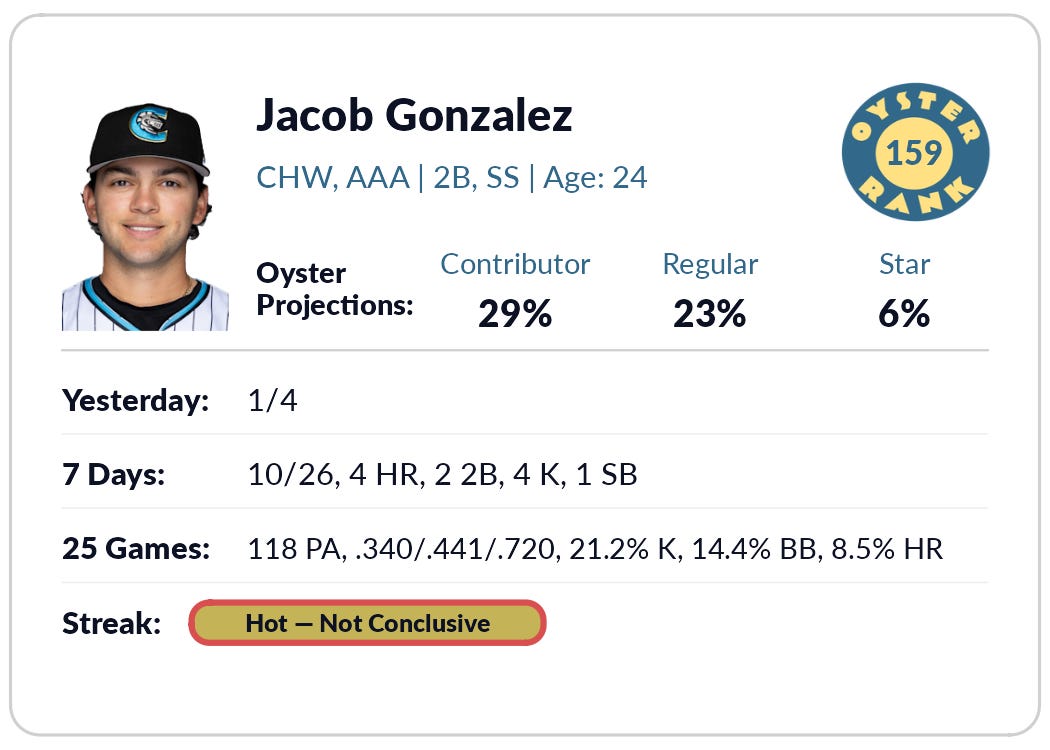
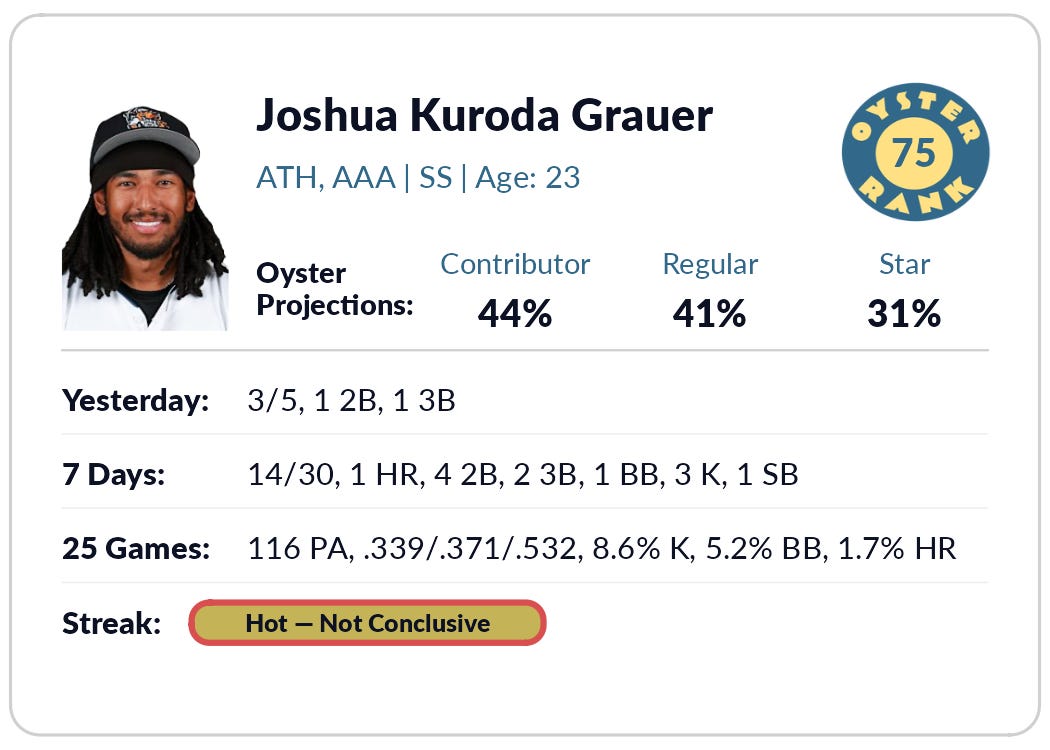
Glossary of Terms
Contributor: A player with an average fWAR of at least 0.5 per 600 plate appearances in their three-season peak. A player who can at least hold down a spot on an MLB roster.
Regular: A player with an average fWAR of at least 1.5 per 600 plate appearances in their three-season peak. A middle-of-the-road or better starter in MLB.
Star: A player with an average fWAR of at least 3.0 per 600 plate appearances in their three-season peak. An All-Star candidate.
Streaks: Each player receives a two-part streak label. The first part (Hot / Lukewarm / Cold) compares their last-25-games OPS to the league average at their level. The second part reflects whether the Oyster Streaks Model thinks the streak has true predictive value, or if it is just noise in the data.
If a player is Hot:
Take Notice (model agrees, this could be real), Not Conclusive (model is neutral), or Mirage (model doesn’t back it up).
If a player is Lukewarm:
Better Than You Think (model sees more than the stats show), Legitimately Boring (model agrees, performance is fine), or Worse Than You Think (model sees less than the stats show).
If a player is Cold:
But He’s Actually Good (model likes the peripherals), Don’t Worry (model agrees it’s temporary), or Get Worried (model agrees with the slump).
Thanks for following! — Oyster Analytics and Down on the Farm
Jacob Gonzalez seems to be a completely different player compared to past years. Already 15 homers and BABIP isn’t that high, what has changed in his profile?